*Reduction in line with 2030 target – NUPRC *Daily gas output reaches 7.59BSCF *Country targets 10BSCF production by 2030
Mkpoikana Udoma & Michael Eboh
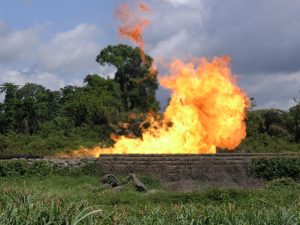
Port Harcourt/Dublin, Ireland — Nigeria’s gas sector has recorded a major breakthrough as the level of gas flaring is declining in its oil and gas operations. According to the Nigerian Upstream Petroleum Regulatory Commission, NUPRC, flaring level dropped from 7.55 percent in 2024 and 7.38 percent in July 2023 to 7.16 percent in July this year.
Also, daily gas production rose to 7.59 billion standard cubic feet, BSCF, in July 2025, NUPRC said.
The Commission’s July 2025 figures reflect an 8.58 percent year-on-year increase in production compared to the 6.99 BSCF recorded in 2024, and a 9.84 percent rise from the 6.91 BSCF achieved in 2023.
“This milestone underscores our sustained regulatory drive to ramp up gas production while progressively reducing flaring in line with Nigeria’s 2030 zero-flare commitment,” NUPRC stated in its latest report.
“We are proving that production growth and flare reduction can move hand-in-hand,” the regulator added.
To achieve these results, NUPRC highlighted programmes such as the Nigerian Gas Flare Commercialisation Programme, NGFCP, a Decarbonisation and Sustainability Blueprint, Carbon Capture and Storage CCS initiatives, and the Upstream Petroleum Decarbonisation Template, UPDT, which integrates sustainability into project planning.
The report also showed progress in meeting the Domestic Gas Delivery Obligation, DGDO. In July, delivery performance reached 72.5 percent, up from 71.8 percent in June. Earlier in the year, DGDO compliance was 72.2 percent in January, 73.5 percent in February, 70.8 percent in March, 73.7 percent in April, and 73.0 percent in May.
On contract performance, Marginal Sole Risk operators contributed 63 percent of July’s output, Production Sharing Contracts, PSCs, accounted for 24 percent, Joint Ventures delivered 10 percent, while Sole Risk operators added 3 percent.
In terms of utilisation, NUPRC disclosed that year-to-date, 35.88 percent of production went to export sales, 27.82 percent was supplied to the domestic market, and 29.13 percent was used for field and plant operations, including fuel, gas lifting, and reinjection for pressure maintenance.
A highlight of the July data was the Gas-to-Power supply, which hit its strongest level in three months.
Daily deliveries rose 3.48 percent from 833.86 million standard cubic feet per day, MMSCF/D, in June to 862.86 MMSCF/D in July 2025.
“The power sector remains a critical anchor for domestic gas utilisation, and the July rebound demonstrates improved supply resilience,” NUPRC said.
Year-to-date figures show fluctuations in Gas-to-Power supply: 780.23 MMSCF/D in January, 849.37 MMSCF/D in February, 886.83 MMSCF/D in March, 886.7 MMSCF/D in April, 837.64 MMSCF/D in May, before the June dip and July rebound.
The Commission emphasised that the July performance reflects its regulatory vision of positioning gas as the “transition fuel” to support Nigeria’s economic growth and energy security.
Overall gas output in July grows by 4.72%
Overall gas production over the month of July grew by 4.72 per cent to 194.179 billion standard cubic feet, BSCF, compared with 185.432 BSCF recorded in the previous month, according to latest data released by the Nigerian National Petroleum Company Limited, NNPC.
The NNPC, in its gas production report for July 2025, stated that the volume of gas produced in the month under review translated to an average daily gas output of 6.264 billion SCF, compared with an average of 6.181 billion SCF per day in June 2025.
The national oil firm noted that the country recorded Associated Gas, AG, output of 114.045 billion SCF, accounting for 58.73 percent of total gas produced in the month under review, while Non-Associated Gas, NAG, output stood at 80.134 billion SCF of gas, accounting for 41.27 percent of total gas production in the month under review.
Giving a breakdown on the utilisation of the country’s gas output in the month under review, the NNPC report stated that a total of 182.462 billion SCF of gas was utilised in July 2025, rising by 4.24 percent from 175.037 billion SCF of gas recorded in June 2025.
In its analysis of total gas utilised in the month under review, the NNPC disclosed that 9.398 billion SCF of gas, representing 4.84 percent of total gas output in July 2025, was used as fuel gas, while 42.34 per cent of total gas produced in the month, 82.209 billion SCF, was utilised by the Nigeria Liquefied Natural Gas, NLNG.
Furthermore, Escravos Gas-to-Liquid, EGTL, utilised 8.556 billion SCF of gas, representing 4.41 percent of total gas output; while Natural Gas Liquid (NGL)/Liquefied Petroleum Gas, LPG, used 2.33 billion SCF of gas, accounting for 1.2 percent of the month’s total gas output.
In addition, the NNPC reported that 26.520 billion SCF of gas or 13.66 percent of total gas produced in the month under review, was sold in the domestic market; while 53.449 billion SCF of gas (27.53 percent of total gas output) was re-injected and used as gas lift make-up.
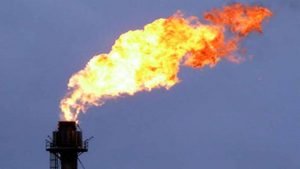
On the other hand, the national oil firm stated that the 11.636 billion SCF of gas flared in the month under review, accounted for 5.99 percent of total gas produced in the country in the month, rising by 12.27 percent compared with 10.364 billion SCF of gas recorded in the previous month.
Country targets 10BSCF production by 2030
In a related development, Nigeria’s Minister of Finance and Coordinating Minister of the Economy, Mr. Wale Edun, has reaffirmed the country’s ambition to produce 10 billion standard cubic feet of gas per day by 2030, declaring that ongoing reforms and new investment deals are already positioning the nation as a competitive gas hub.
He disclosed this while speaking during a strategic engagement with the management of Nigeria LNG Limited, NLNG.
“Nigeria has set its sights on producing 10 billion standard cubic feet of gas per day by 2030. Recent agreements, including the Deepwater deal with TotalEnergies, are clear evidence of progress toward a more competitive and investor-friendly environment.
“The President has stabilised the economy and created new opportunities for both manufacturing and energy. As we implement comprehensive tax reforms, your input will be vital in shaping a more attractive business landscape,” Edun told the NLNG team.
The Minister assured industry stakeholders that government reforms would build transparency and efficiency into Nigeria’s gas and trade ecosystem.
“We want a transparent, technology-driven environment where investors can operate with confidence. The rollout of digital trade systems will streamline oversight, eliminate inefficiencies, and ensure fairness,” he stated.
Nigeria’s push to boost gas production is aligned with the Federal Government’s plan, which seeks to leverage the country’s energy endowment to drive economic growth, expand manufacturing, and attract foreign direct investment.
“With renewed focus and determination, Nigeria is poised to unlock its vast energy resources and drive economic growth,” Edun stated.
On his part, NLNG’s Managing Director and Chief Executive Officer, Dr. Philip Mshelbila, briefed the Minister on operational progress, reporting stronger gas supply and improved security along the Trans-Niger pipeline.
He also disclosed that NLNG’s plant capacity utilisation had risen above 70 percent.
“We are seeing positive results in gas supply reliability and in securing critical infrastructure. Our capacity utilisation has climbed above 70 percent, reflecting the resilience of our operations,” Dr. Mshelbila said.