– Evidence of a take-off in solar in Africa
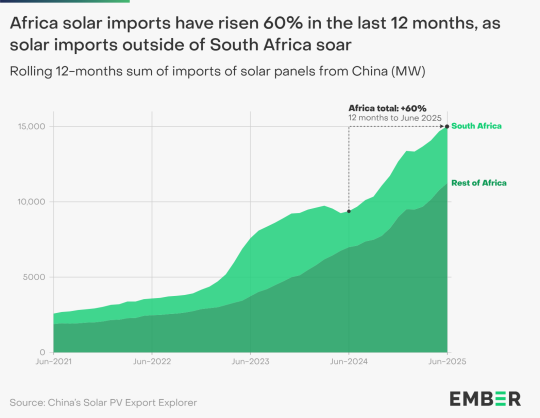
London, United Kingdom — Solar panel imports into Africa rose by 60% in the 12 months to June 2025, according to a new analysis of China’s solar panel exports data from energy think tank Ember. The data shows how the rise happened across Africa, and it is at a scale to impact the electricity system of many countries.
Solar imports rise across most African countries in the 12 months to June 2025
The analysis shows that Africa’s solar panel imports set a new record in the 12 months to June 2025, reaching 15,032 MW – a 60% increase on the 9,379 MW imported in the preceding 12 months.
The last time imports surged was in 2023, when South Africa solar imports picked up as the power crisis hit its peak. However, this time is different – much of the pick-up in the last 12 months happened outside of South Africa. 20 countries set a new record for the imports of solar panels in the 12 months to June 2025. 25 countries imported at least 100 MW, up from 15 countries 12 months before.
In the last 12 months to June 2025, Nigeria overtook Egypt to become the second-largest importer with 1,721 MW of solar panel imports in the past year, while Algeria ranked third with 1,199 MW.
Some countries recorded very high growth rates. Algeria’s imports rose 33-fold, Zambia eightfold, Botswana sevenfold, and Sudan sixfold, while Liberia, DRC, Benin, Angola and Ethiopia all more than tripled their imports.
Despite these record imports of solar panels, there is no data to know how many have yet been installed. “Bottom-up energy transitions fueled by cheap solar are no longer a choice – they’re our future. Tracking these additions is what makes the difference between a messy shift and an organised, accelerated one,” said Muhammad Mustafa Amjad, Program Director at Renewables First. “When you don’t track, you lose time and opportunities. Pakistan’s experience shows this clearly. Africa’s transition will happen regardless, but with timely data it can be more equitable, planned and inclusive.”
The analysis finds that recent imports could make a major contribution to electricity generation in many African countries. If fully installed, imports in Sierra Leone in the last 12 months could generate electricity equivalent to 61% of reported electricity generation in 2023, while in Chad the figure is 49%. Liberia, Somalia, Eritrea, Togo and Benin could see generation rise by more than 10% of reported 2023 generation. In total, 16 countries could see an increase of over 5%.
The report describes how solar panel imports may actually reduce overall imports. The savings from avoiding diesel can repay the cost of a solar panel within six months in Nigeria, and even less in other countries. In nine of the top ten solar panel importers, the import value of refined petroleum eclipses the import value of solar panels by a factor of between 30 to 107.
More data and evidence needed to unlock potential
Further evidence is urgently needed to understand the rapid rise in solar across Africa and its potential to expand electricity systems. No single data source captures the full picture, and much more research and reporting are required.
Dave Jones, Chief Analyst at Ember, said: “The take-off of solar in Africa is a pivotal moment. This report is a call to action, urging stronger research, analysis and reporting on solar’s rise to ensure the world’s cheapest electricity source fulfils its vast potential to transform the African continent.”
This surge is still in its early days. Pakistan experienced an immense solar boom in the last two years, but Africa is not the next Pakistan – yet. However, change happens quickly. And the first evidence is now here.