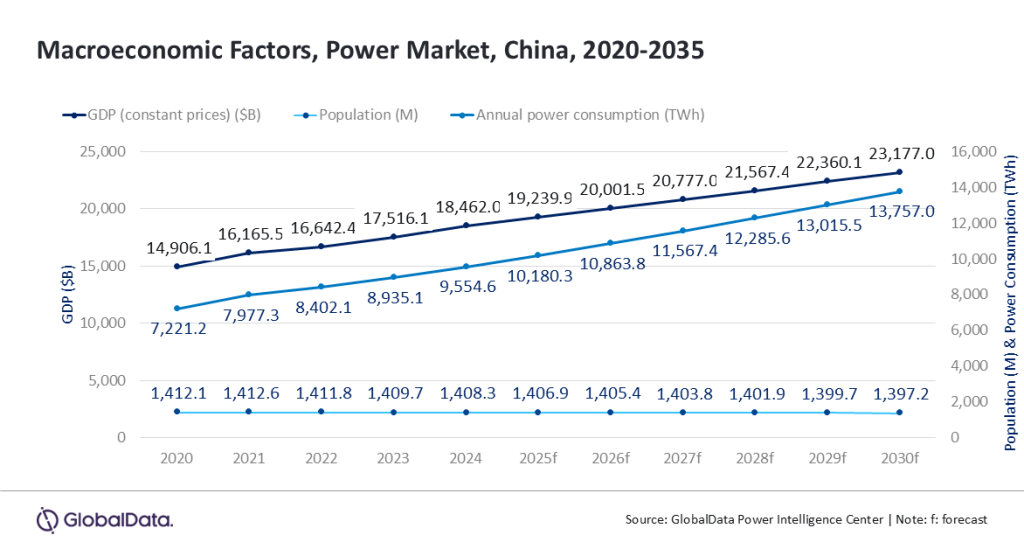
Lagos — China’s electricity consumption continues to outpace its gross domestic product (GDP) growth, driven by a shift toward energy-intensive industries and the rapid electrification of transportation and digital infrastructure. The robust increase in electricity demand is progressively supported by clean energy. The country’s power consumption is forecast to reach 13,757TWh in 2030, registering a compound annual growth rate (CAGR) of 6.3% during 2024-30, according to GlobalData, a leading data and analytics company.
GlobalData’s latest report, “China Power Market Outlook to 2035, Update 2025 – Market Trends, Regulations, and Competitive Landscape,” reveals that China’s real GDP (in USD, 2015 prices) is set to increase from $2,018.8 billion in 2024 to $2,319.9 billion in 2030, driving the demand for electricity. Despite a decline in China’s population from 1,412 million in 2020 to 1,410 million in 2024, the electricity consumption has consistently shown over 6% growth in recent years, and the trend is expected to continue with rapid industrialization and electric vehicle (EV) infrastructure development.
China Outlook 2025 PR.png
Attaurrahman Ojindaram Saibasan, Senior Power Analyst at GlobalData, comments: “In recent years, China’s electricity consumption has expanded at a significant pace relative to that of other nations. The growth in generation from hydropower and renewable energy sources has resulted in excess generation capacity at numerous coal-fired power plants. Consequently, the Chinese government has imposed a moratorium on the construction of new coal-based facilities in the key economic regions of Hong Kong, Shanghai, and Beijing.”
As China pivots from heavy industries to service and high-tech sectors, and increasingly emphasizes sustainable development, the demand for coal is anticipated to decline further. Nonetheless, coal is projected to remain the predominant source of power generation throughout the forecast period.
Saibasan adds: “In the short term, China is confronted with the challenges of elevated energy costs and commodity prices. However, its partnership with Russia is expected to present an opportunity to secure oil, coal, and gas imports through advantageous agreements.”
In 2024, the industrial sector occupied a dominant share in power consumption, accounting for 67%. This was followed by the residential sector with 15.6%, and the commercial sector with a share of 4.4%. The transport sector held a share of 2.3% whereas other segments contributed to 10.7% share.
Emerging industries, including EVs, artificial intelligence (AI), data centers, semiconductors, and 5G infrastructure, are experiencing rapid growth. These sectors are notably electricity-dependent and are anticipated to propel the demand for power within the country.
Saibasan continues: “China presents three principal areas of investment opportunity: gas-based power generation, renewable power generation, and smart grid infrastructure. The prospects for gas-based generation are poised to increase, driven by the government’s initiative to curtail coal-based power generation. The country has achieved significant advancements in renewable power, with wind and solar energy poised for continued expansion.”
Saibasan concludes: “The country is also committed to expanding its offshore wind sector by aligning the cost of electricity with the market price. Although offshore wind projects involve higher expenses than their onshore counterparts, China is addressing these challenges by constructing larger turbines. Furthermore, the government’s commitment to enhancing the public electricity supply infrastructure and increasing efficiency is expected to generate investment opportunities in smart grids.”