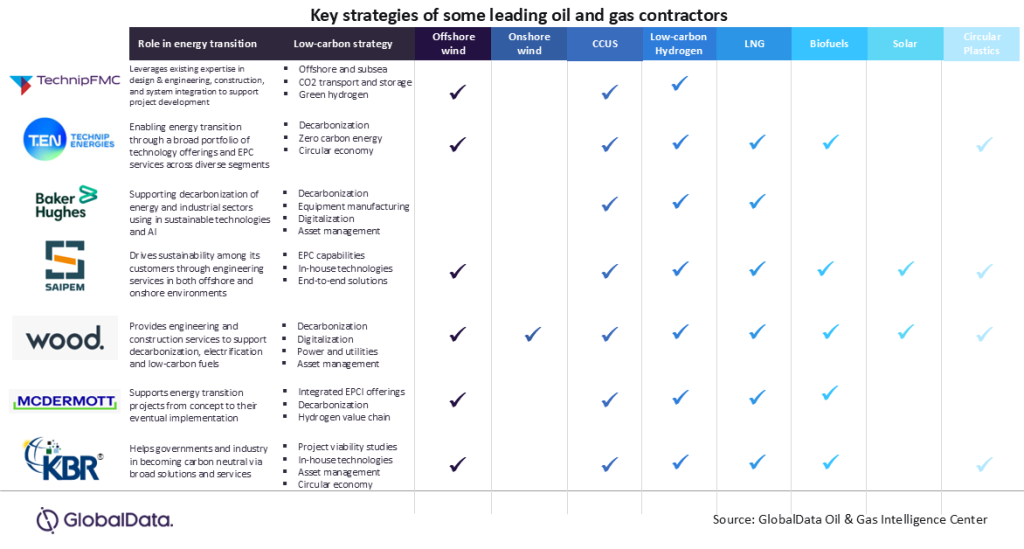
Lagos — Contractors, that traditionally focused on oil and gas project installations and allied works, have become central to the industry’s decarbonization push, with their engineering decisions and technology portfolios now determining the speed and feasibility of low-carbon developments.
By advancing carbon capture, utilization and storage (CCUS), low-carbon hydrogen, bioenergy, and efficiency-focused design, they are reshaping project economics and guiding operators’ transition pathways across the energy value chain, says GlobalData, a leading data and analytics company.
GlobalData’s Strategic Intelligence report, “Energy Transition Strategies in Oil and Gas Contractors,” notes that several oil and gas contractors, such as Technip Energies, Wood, McDermott, Saipem, and SLB are developing and offering technologies for emission reduction. They act as intermediaries, which translate corporate decarbonization strategies into practical operational and technological outcomes.
The role of contractors spans from advisory to technical execution and regulatory compliance, acting across upstream, midstream, and downstream operations. They also foster innovation, set up resilient supply chains, and drive efficiency to streamline project costs while ensuring optimum quality levels from the end product.
Ravindra Puranik, Oil and Gas Analyst at GlobalData, comments: “Contractors are expanding their portfolio offerings to include core technologies, such as CCUS, energy recovery, flaring reduction, and methane monitoring to detect leaks, measure emissions, mitigate and utilize them for productive purposes. Several of these have also ventured into the power generation and utilities sector to diversify their offerings in line with their traditional oil and gas clientele. Nevertheless, this market is still dominated by power contractors, including Vestas and Siemens.”
According to GlobalData, many contractors are specializing in specialised engineering and construction across diverse low-carbon initiatives to support oil and gas operators in mitigating emissions. Their engineering choices and cost curves materially affect the project viability and speed to market.
Puranik adds: “Some contractors, such as Honeywell, Topsoe, and Maire (NextChem), are predominantly known for their technology offerings. Besides, industrial gas producers, such as Air Liquide, Air Products and Linde, also offer end-to-end services on CCUS and low-carbon hydrogen production.”
Of late, low-carbon energy developments have faced some setbacks due to technical, regulatory and financing challenges. Inflation has compounded cost volatility, forcing companies to reconsider projects even when binding offtake agreements exist. Developers essentially relying on government subsidies and grants have had to rethink their project plans, causing delays and even cancellations.
Puranik concludes: “Instances such as the rollback of the Inflation Reduction Act in the US can somewhat hinder the push for clean energy due to economic pressures. Naturally, such developments do have a bearing on contracting activity as well. Hence, it is imperative for oil and gas contractors to follow a balanced approach in their expansion plans towards low-carbon energies.”