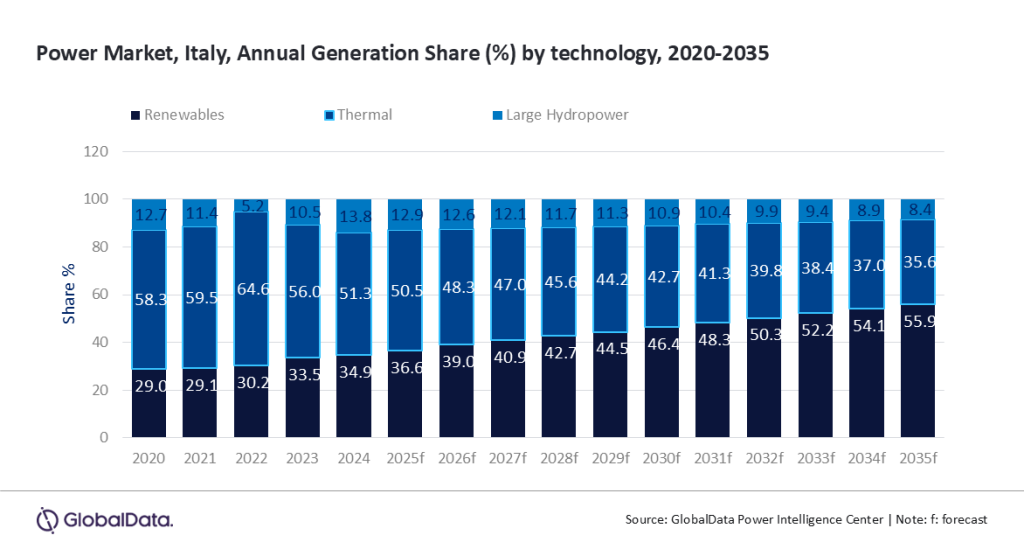
Lagos — Italy has been promoting the development of renewable energy through its principal energy strategies and policies, including the National Energy Strategy and the Integrated National Plan for Energy and Climate, while also emphasizing energy security. As a result, renewables are projected to overtake thermal power as the primary source of Italy’s electricity generation in 2030 and will continue to increase their share to 55.9% in 2035, according to GlobalData, a leading data and analytics company.
GlobalData’s latest report, “Italy Power Market Outlook to 2035, Update 2025 – Market Trends, Regulations, and Competitive Landscape,” reveals that renewable power dominated Italy’s capacity mix in 2024 with 43.4% share. It is expected to be the leading technology in 2035, accounting for 70.6% share. This was closely followed by thermal power, which accounted for 42.3% capacity share in 2024 and is expected to see a decline to 21.4% in 2035. In 2024, thermal power dominated generation mix with 51.3%, while renewables accounted for 34.9%. Large hydropower accounted for the remaining 13.8% share.
Attaurrahman Ojindaram Saibasan, Senior Power Analyst at GlobalData, comments: “Italy is not known for possessing substantial domestic fossil fuel reserves and is heavily dependent on imports. As the second-largest importer of gas in Europe, after Germany, Italy sources natural gas from Azerbaijan, Algeria, Libya, and other nations. Italy meets most of its gas requirements through imports, which may offer a short-term solution. However, the government is actively seeking to expand renewable energy capacity to reduce reliance on foreign sources.
“At present, Italy is poised to invest in two primary sectors: solar and wind power generation. Driven by its substantial potential and environmental objectives, the government has resolved to elevate the proportion of renewable energy in its total energy consumption to 40% by 2030.”
Italy targets to achieve 40% renewable share in gross final consumption and 65% renewable electricity generation by 2030. The country has a target to have 27% of its power capacity from renewables by that year. It aims to increase its total renewable installed capacity to 93.2GW and 186.8TWh power generation through renewables by 2030. It targets to achieve 50GW of solar PV capacity, 74TWh power generation through solar PV and 18.2 GW of wind capacity by 2030.
A primary force shaping Italy’s power market is its dedication to climate objectives, both at the national level and as a member of the European Union (EU). Italy is obligated to adhere to the EU’s “Fit for 55” package and the European Green Deal, which collectively seek to reduce greenhouse gas emissions by at least 55% by 2030 and to achieve net-zero emissions by 2050.
Saibasan continues: “These ambitious targets have compelled Italy to expedite the decarbonization of its electricity sector, transitioning from fossil fuel-based power generation to renewable energy sources, including solar, wind, and hydropower. The national strategy places a significant emphasis on the electrification of end-use sectors—transportation, heating, and industry—which is anticipated to markedly increase electricity demand. This ongoing transformation is guiding investment decisions, grid modernization, and infrastructure planning throughout the power market.”
Saibasan concludes: “The landscape of Italy’s power sector has undergone significant changes over the past few decades, and the nation is anticipated to transition to a green energy-based economy in the foreseeable future. Nevertheless, Italy faces several obstacles that need to be addressed. The primary challenge within the power sector is the country’s heavy reliance on energy imports, particularly from France and Switzerland.”