Lagos — A joint research team from Jeonbuk National University and Korea Institute of Materials Science have demonstrated promising alumina-forming ferritic alloys that exhibit high-temperature oxidation resistance even under prolonged steam exposure.
They achieve an outstanding balance between steam oxidation resistance, high-temperature strength, and cost- effectiveness, making them lucrative for high-temperature structural applications in extreme environments.
This is a response to the increasing demand for novel materials with high-temperature oxidation resistance in harsh environments.
The emergence of carbon-neutral energy systems such as high-temperature electrolysis, solar thermal power plants, small modular reactors, and hydrogen- and ammonia-based processes has necessitated the development of novel structural materials that exhibit outstanding corrosion resistance and mechanical properties even at high temperatures and under harsh environments. Notably, traditional austenitic stainless steels (ASSs) fail in these conditions.
Addressing this technological gap, materials science engineers have come up with Ni- and Fe-based heat-resistant alloys, including Nimonic, Inconel, and Ni-Cr-Al alloys, and 304 L/316 L ASS, oxide dispersion-strengthened, and alumina-forming austenitic (AFA) steels, respectively.
While these existing materials possess protective chromia (Cr2O3) and/or α-alumina (Al2O3) oxide scales, they also suffer from various limitations. Therefore, there is an urgent need to design cost-efficient self-protecting alloys with active α-Al2O3 scale formation capability and high-temperature phase stability.
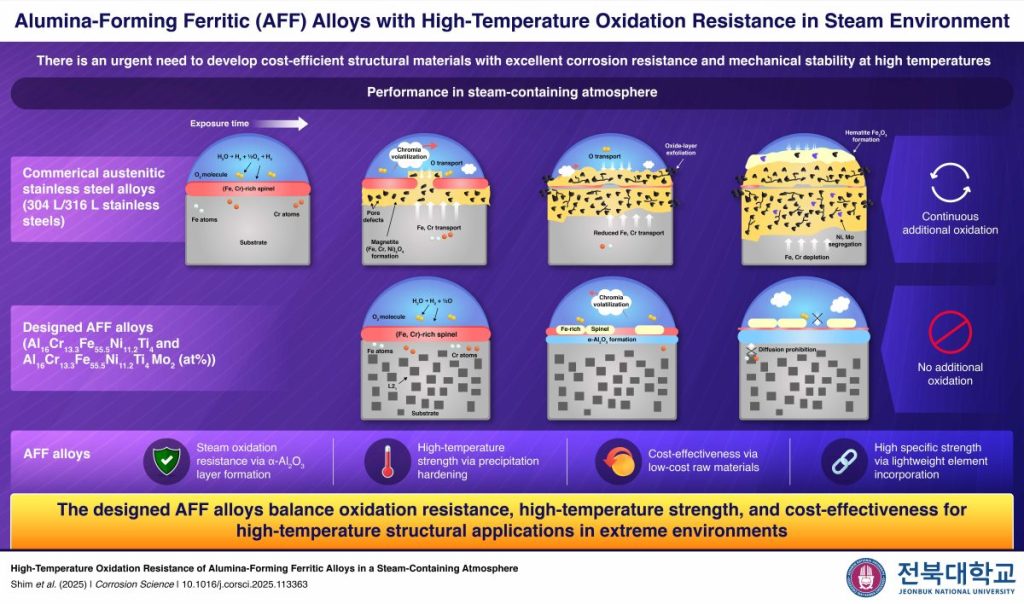
Recently, in an innovative breakthrough, a team of researchers from the Republic of Korea, led by Associate Professor Jae-Gil Jung from the Division of Advanced Materials Engineering at Jeonbuk National University and Principal Researcher Ka Ram Lim from the Extreme Materials Research Institute at Korea Institute of Materials Science (KIMS), and including postdoctoral researchers Dr. Sang-Hwa Lee and Dr. Sang Hun Shim from each institute, developed alumina-forming ferritic (AFF) alloys using the concept of high-entropy alloys. These AFF materials are expected to exhibit superior oxidation resistance via α-Al2O3 layer formation, high-temperature mechanical strength via precipitation hardening, as well as specific strength via lightweight element incorporation.
Now, the researchers have investigated the high-temperature steam oxidation behavior of their earlier reported AFF alloy Al16Cr13.3Fe55.5Ni11.2Ti4 (at%) and its new variant containing an extra 2 at% Mo. Their present findings were made available online on October 12, 2025 and have been published in Volume 258 of the journal Corrosion Science on January 1, 2026.
“Our research presents a novel alloying strategy that simultaneously improves heat resistance and oxidation/corrosion resistance while maintaining economic feasibility. This dual improvement is important because it enables materials to stay stronger and more durable in extreme high-temperature environments,” remarks Prof. Jung.
In this study, the team investigated the oxidation behavior of their designed AFF alloys under a steam-containing atmosphere at 700 °C for 500 hours. While the ASS alloy undergoes rapid oxidation under steam owing to Cr2O3 scale volatilization, AFF alloys developed a dense 100-nm α-Al2O3 layer after prolonged exposure, thereby suppressing oxygen diffusion and achieving long-term stability.
“The body-centered cubic-based AFF alloys can accommodate much higher amounts of Al than face-centered cubic-based AFA alloys, making them more favorable for the formation of a uniform and dense protective scale,” explains Dr. Lim.
AFF alloys also demonstrate superior high-temperature specific yield strength comparable to that of Ni-based superalloys. Notably, Mo addition provides mechanical strengthening without compromising oxidation resistance.
The present findings can benefit a wide range of technologies that operate under extreme conditions, with potential real-life applications including reusable space launch vehicles, advanced armor materials, molten salt reactors, thermal energy storage systems, high-temperature steam electrolysis, ammonia-cracking reactors, and lithium-ion battery recycling. These fields demand materials that can remain strong and resistant to chemical degradation at high temperatures.
For these materials to make a real impact in everyday life, they must offer not only high reliability but also strong economic feasibility. This work addresses this concern by focusing on low-cost alloy systems, which could accelerate their adoption in practical, large-scale applications in the coming 5-to-10 years.