Precious Anga
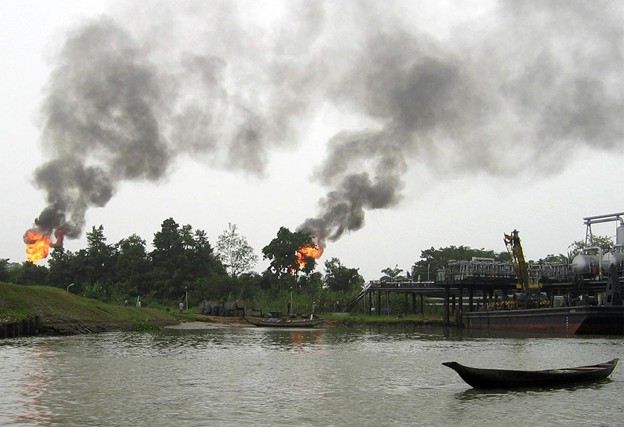
Lagos — Nigeria lost an estimated 62,400 gigawatt-hours, GWh, of potential electricity generation from gas flaring between 2024 and 2025, underscoring the country’s continued struggle to convert its abundant natural gas resources into reliable domestic power despite years of policy interventions aimed at eliminating routine flaring.
Industry data show that the volume of electricity lost during the two-year period represents an 18.6 per cent increase compared with the estimated 50,800GWh of generation potential lost between 2022 and 2023, even as major oil-producing countries increasingly capture associated gas for electricity generation, industrial feedstock and export.
Figures obtained from the National Oil Spill Detection and Response Agency, NOSDRA, indicate that the economic value of gas flared during the period reached $2.2 billion, while oil producers that failed to comply with flare regulations are liable for penalties estimated at $1.2 billion.
The agency disclosed that operators flared 380.6 million standard cubic feet,SCF, of gas from onshore facilities, significantly higher than the 243.8 million SCF flared offshore. According to NOSDRA, the wasted gas generated approximately 33.2 million tonnes of carbon dioxide, CO₂, emissions, further worsening Nigeria’s environmental footprint.
Despite successive government initiatives, including higher gas-flaring penalties and policies promoting gas commercialisation, NOSDRA said routine flaring remains widespread, resulting in the loss of valuable energy resources while contributing substantially to greenhouse gas emissions.
The latest findings are consistent with the World Bank’s Global Gas Flaring Tracker Report, which ranked Nigeria among the nine largest gas-flaring countries globally in 2025, alongside Russia, Iran, Iraq, Venezuela, Mexico, Libya, Algeria and the United States.
According to the report, those nine countries accounted for 83 per cent of global gas flaring despite producing only 46 per cent of the world’s crude oil. Global gas flaring increased to 167 billion cubic metres, bcm, in 2025, with Nigeria accounting for approximately nine bcm, making it the seventh-largest gas-flaring nation worldwide.
Reacting to the development, Professor Emeritus of Petroleum Economics, Prof. Wumi Iledare, said the continued increase in gas flaring reflects deeper structural weaknesses within Nigeria’s energy sector rather than simply inadequate enforcement of environmental regulations.
He argued that the persistent waste of associated gas demonstrates the absence of a commercially viable gas-to-power value chain capable of converting stranded gas into electricity and industrial energy.
“Gas flaring in Nigeria is not merely an environmental issue; it reflects a failure of power market economics, gas commercialisation and sector governance. Every molecule of gas flared represents lost opportunities to generate electricity, support industries, create jobs, earn export revenues and strengthen energy security.”
According to Iledare, the country’s inability to significantly reduce gas flaring stems from inadequate gas gathering infrastructure, pricing distortions, regulatory inefficiencies and an electricity market that remains financially weak and incapable of providing confidence to upstream gas suppliers.
He explained that many producers still consider flaring the least costly option because the domestic gas market does not provide sufficient commercial incentives to justify large-scale investments in gas gathering and processing infrastructure.
“The challenge is rooted in inadequate gas gathering infrastructure, an illiquid electricity market, pricing distortions and regulatory inefficiencies, all of which make flaring the easier option.”
While acknowledging that stricter penalties remain necessary to discourage wasteful practices, Iledare stressed that enforcement alone cannot resolve the problem unless supported by broader reforms across the gas and electricity value chains.
“While higher flare penalties are necessary, penalties alone will not solve the problem. They must be complemented by policies that encourage gas capture, infrastructure investment, market-based pricing and a financially sustainable electricity market where gas producers are assured of timely payment.”
His remarks reinforce growing calls for accelerated investment in gas processing facilities, pipeline infrastructure and electricity market reforms as Nigeria seeks to maximise value from its more than 200 trillion cubic feet of proven natural gas reserves.
Industry analysts argue that reducing routine gas flaring could significantly improve electricity generation, support industrial expansion, lower carbon emissions and strengthen Nigeria’s energy security while creating additional export revenue from gas that is currently being wasted.