Mkpoikana Udoma
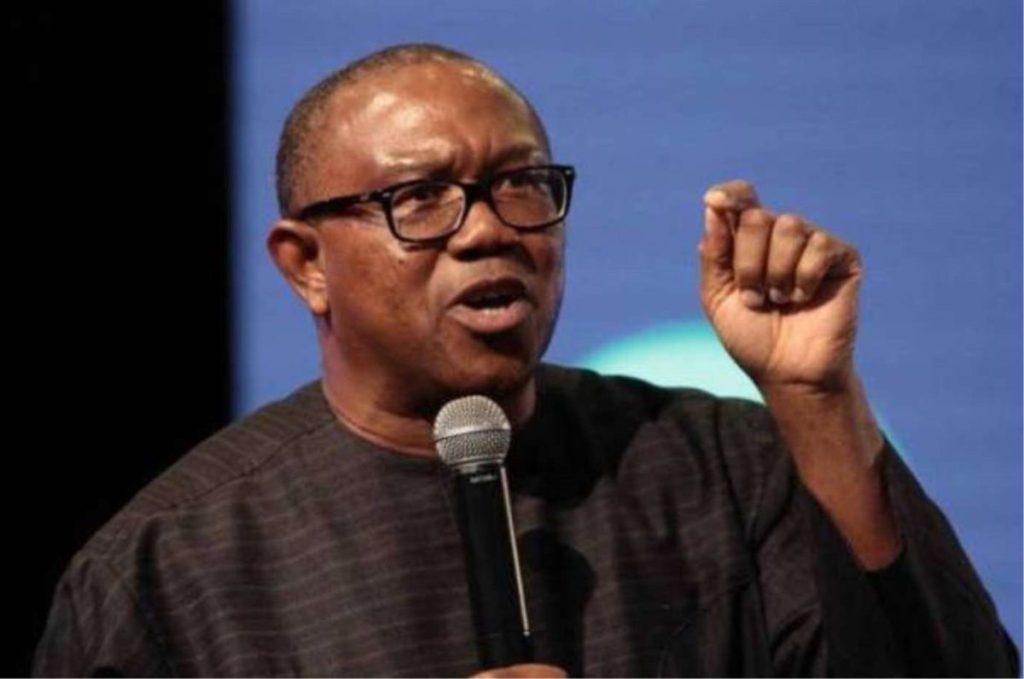
Port Harcourt — Former presidential candidate, Mr. Peter Gregory Obi, has decried Nigeria’s dwindling Foreign Direct Investment, FDI, inflows, warning that poor leadership and uncoordinated reforms are driving away long-term investors despite government’s constant foreign trips in search of capital.
According to the National Bureau of Statistics, NBS, FDI into Nigeria dropped sharply by 70 percent in the first quarter of 2025, falling to $126.29 million from $421.8 million recorded in the last quarter of 2024.
Of the total $5.64 billion capital importation into Nigeria in Q1 2025, FDI accounted for only 2.24 percent, compared to 8.2 percent in Q4 2024. The bulk of inflows, nearly 90 percent, went into speculative money market instruments.
Reacting to the figures, Obi said such inflows have little impact on industrial growth or job creation.
“With such a high proportion of capital importation flowing into speculative investments, the impact on industrial growth or job creation is highly insignificant and elusive, given the ease with which such ‘hot money’ can exit the economy,” he stated.
He argued that Nigeria’s declining performance in key governance indicators, rule of law, regulatory quality, government effectiveness, and accountability, shows that leadership failure is the biggest obstacle to attracting sustainable investments.
“You cannot attract sustainable foreign investment with poor leadership and governance,” Obi stressed.
The Labour Party’s 2023 presidential flagbearer pointed out that capital flows to the manufacturing sector dropped by 32.1 percent, sliding to $129.92 million in Q1 2025 from $191.92 million in the same quarter of 2023.
“There is no better confirmation of the lack of trust in this government, whose reforms remain uncoordinated and largely reactive,” he said.
Comparing Nigeria’s performance with other African countries, Obi highlighted that while global FDI flows fell in 2024, Africa’s inflows surged to $97 billion, a 75 percent rise from 2023. Egypt topped the continent with $46.58 billion, followed by Ethiopia, Côte d’Ivoire, Mozambique, Uganda, DR Congo, South Africa, Namibia, Senegal, Guinea, and Morocco.
“Most disappointingly, our dear nation, Nigeria, the so-called ‘Giant of Africa’ received only $1.08 billion, about 1 percent of Africa’s total FDI, representing a decline of about 42 percent from 2023,” he lamented.
He noted that after the 42 percent drop in 2024, FDI to Nigeria has now further crashed by 75 percent between Q4 2024 and Q1 2025. “We cannot achieve sustainable growth and development with ineffective leadership and a weak government,” Obi warned.
Ending on an optimistic note, Obi maintained that reforms anchored on good governance could reverse the trend. “A New Nigeria is possible,” he declared.