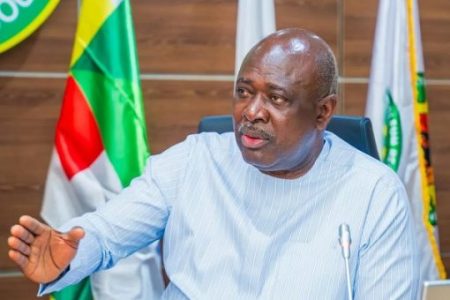
Lagos — The Executive Secretary of the Nigerian Content Development and Monitoring Board, NCDMB, Engr. Simbi Kesiye Wabote, says the Nigerian oil and gas industry is poised for a boost in production, employment creation, and capital injection with the current divestment of assets by some international oil and gas companies and acquisition of such assets by Nigeria companies.
Wabote stated this at the 2023 Petroleum and Natural Gas Senior Staff Association of Nigeria, PENGASSAN, Energy and Labour Summit in Abuja, where he delivered the keynote address on “Divestments in Oil and Gas: The challenges, the opportunities, and the implications to the industry in Nigeria”.
Quoting the AfricaReport magazine, he said about 26 oil mining licenses have been divested or acquired by oil and gas companies in the Niger Delta Basin area of Nigeria in the past decade. Some of the divestments currently on the cards include the plan by Shell and ExxonMobil to sell oil and gas assets worth billions of dollars, in addition to Eni’s announcement in September of an agreement with Oando PLC for the sale of NAOC interests in 6 onshore blocks and Okpai gas power plant in, Delta State.
He emphasised that divestments of oil assets are not necessarily negative, rather they present an avenue for the local capacities and capabilities that have been developed through local content implementation to be brought to bear in the upstream sector.
Wabote outlined several opportunities that would accrue from divestments, such as the injection of new capital, the rejuvenation of divested assets, and an increase in crude oil production through the investment in technologies by the acquiring firms.
Other direct benefits are the creation of direct and indirect employment opportunities by the indigenous companies and their service providers.
The NCDMB boss reiterated that the divestments confirm that Nigerians and indigenous companies have come of age and have acquired the technical, managerial, and financial capabilities to play in the “big league”.
He added that “the involvement of our financial institutions on the transactions represents means of efficient capital deployment and capacity building on loans syndication on an international scale. This is also applicable to legal services, insurance, government relations, employee relations, community liaison, and others.”
Aside from the opportunities, the NCDMB boss equally highlighted challenges encountered in the divestment exercises. These revolved around the time required to get necessary regulatory approvals as well as the substantial interests from various groups covering political, legal, communities, and labour.
Among other challenges are the potential for the disruption of oil and gas production, job losses, as well as access to the latest technology especially if the new investors lack the technical expertise or have no support from original equipment manufacturers. There are also issues around how to manage legacy issues or liabilities related to the environment, communities, and other social commitments and pressure on new investors to recoup investments on time to offset loans and address other financial requirements.
Wabote assured that the Board would continue to partner with industry stakeholders to institute regulations that would ensure that the increasing footprints and stakes of indigenous oil and gas production companies would not lead to a reduction in Nigerian content compliance. He promised that the Board would continue to partner with PENGASSAN to shape a future where Nigeria’s energy industry not only survives but thrives in the face of change.