Lagos — South Korea relies solely on domestic production for its electricity needs, as it lacks interconnections with neighboring countries and does not engage in the import or export of electricity.
The nation’s capacity to manage domestic electricity demand effectively is attributed to its substantial nuclear power generation infrastructure. In 2022, the nation reversed a policy to phase out nuclear energy and positioned it as a pivotal element of its energy strategy.
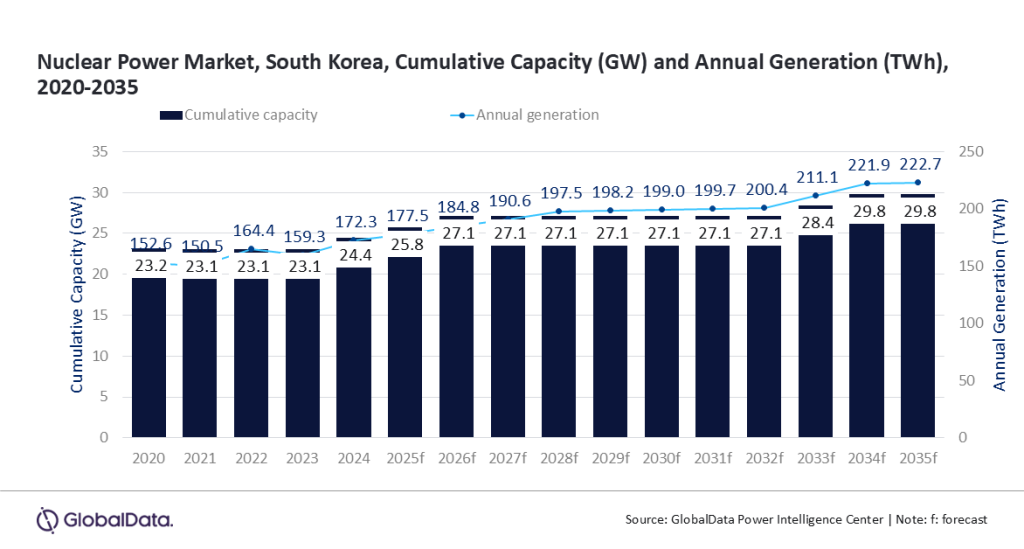
Against this backdrop, nuclear power generation of the country is forecast to reach 222.7TWh in 2035, registering a compound annual growth rate (CAGR) of 2.4% during 2024-35, according to GlobalData, a leading data and analytics company.
GlobalData’s latest report, “South Korea Power Market Outlook to 2035, Update 2025 – Market Trends, Regulations, and Competitive Landscape,” reveals that nuclear power capacity in the country increased from 23.2GW in 2020 to 24.4GW in 2024. It is expected to increase at a CAGR of 1.8% during 2024-35 to reach 29.8GW. The country has 25 active reactors and four upcoming reactors under construction. Nuclear power contributes to meeting nearly one-third of South Korea’s electricity consumption.
Attaurrahman Ojindaram Saibasan, Senior Power Analyst at GlobalData, comments: “South Korea stands as one of the most significant consumers of energy and ranks among the leading greenhouse gas (GHG) emitters globally. The country currently grapples with the dual challenge of bolstering energy security and reducing carbon emissions. The nation’s reliance on thermal and nuclear power to satisfy domestic electricity needs is notable. The utilization of fossil fuels for thermal power not only escalates emissions but also, due to scant natural reserves, necessitates the costly importation of coal and gas.”
South Korea’s dependence on nuclear power generation incurred significant expenses when two of its then 26 nuclear reactors were shut down in November 2012, following the discovery of substandard components. With peak demand surging and generation falling short, the country faced a reserve margin of less than 10%.
The 11th Basic Plan for Long-Term Electricity Supply and Demand sets forth an ambitious goal to increase the share of nuclear power in electricity generation to 35.2% by 2038. This plan includes the construction of three additional nuclear reactors and one small modular reactor (SMR) by 2038, thereby augmenting capacity by approximately 4.4GW. Furthermore, South Korea aspires to establish itself as a leading exporter of nuclear energy, aiming to secure contracts for the construction of 10 nuclear reactors overseas by 2030.
Saibasan concludes: “South Korea intends to expand its nuclear energy capabilities, thereby solidifying the role of nuclear power within its energy portfolio. Domestic nuclear enterprises are increasingly recognized on the global stage, securing contracts in nations such as the Czech Republic and achieving successful completion of international projects, including the United Arab Emirates’ Barakah nuclear plant.
“However, the impeachment of President Yoon Suk-yeol in April 2025 has cast a shadow of uncertainty over South Korea’s nuclear policy. The potential for policy reversals or modifications looms, contingent upon the results of forthcoming elections.”