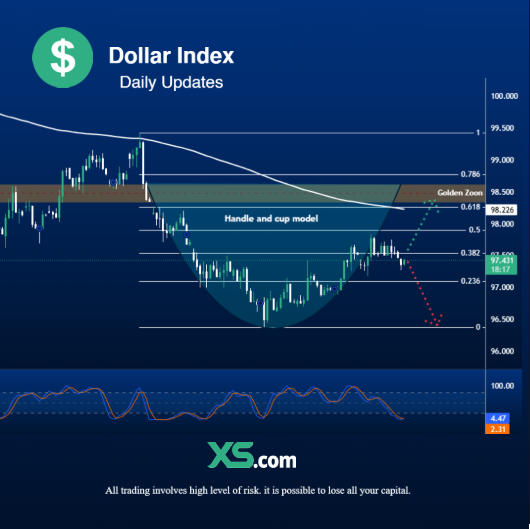
Lagos — The U.S. Dollar Index (DXY) saw a notable decline to 97.30, down from its two-week high, following President Donald Trump’s announcement of a new round of tariffs targeting several developing and emerging economies. This 0.17% drop reflects the market’s immediate reaction to renewed trade tensions amid widespread concerns over the implications of protectionist policies on both the U.S. and global economies.
In my view, markets remain highly sensitive to Trump’s trade strategy, which lacks consistency and clarity, representing a major source of uncertainty that undermines investor confidence and affects capital flows.
The announcement of a 50% tariff on Brazil—a relatively high rate—carries both political and economic implications and suggests that the U.S. administration continues to use tariffs as a negotiating tool and a national security shield. The inclusion of countries like Algeria, Libya, Iraq, and Sri Lanka further raises questions about the underlying motivations and timing of this escalation, particularly at a time of market fragility. I believe these moves may result in a slowdown in trade flows and an increase in production costs across multiple U.S. sectors, especially industrial ones, thereby amplifying inflationary pressures in the short term while eroding the global competitiveness of U.S. companies in the long run.
Additionally, Trump’s decision to impose a new 50% tariff on copper imports, effective August 1st, following a national security review, indicates a deepening trend toward economic isolationism within the White House. This policy stance sends negative signals to global markets, reminiscent of the U.S.-China trade war in 2018–2019, which triggered intense market volatility and weakened U.S. consumer confidence. In my assessment, these new tariffs won’t only exert pricing pressure but could also destabilise domestic economic stability by increasing input costs, which may ultimately dampen U.S. economic growth momentum.
The Federal Reserve meeting minutes added another layer of complexity to the economic landscape, revealing a clear division among officials regarding the outlook for the U.S. economy. While some members expressed willingness to cut interest rates soon, the majority remained concerned about the inflationary consequences of the new tariffs. These divisions underscore the fragile nature of the current economic environment and signal that the Fed stands at a critical crossroads: either to accommodate short-term inflation shocks through monetary easing or to uphold a hawkish stance in anticipation of sustained price pressures. In my opinion, the more likely scenario is a limited rate cut in the coming months as a precautionary move, particularly if negative data accumulates from the labour market and the manufacturing and services sectors.
Although some Fed participants believe the inflationary impact of tariffs will be temporary or modest, ignoring the cumulative effects of these policies could pose a serious threat to market stability. Even partial tariffs contribute to an atmosphere of uncertainty, discouraging corporate investment and consumer spending, potentially triggering a negative feedback loop that is difficult to break under a neutral or delayed monetary response. Therefore, I believe that flexibility in the Fed’s current stance is necessary, but it must be contingent on greater clarity regarding the direction of trade policy.
In the near term, U.S. weekly jobless claims data will be a key driver of the dollar’s short-term path. If the report shows an unexpected improvement in the labour market, it could temporarily support the dollar and give the Fed more room to pause policy shifts. However, if the numbers disappoint, it may accelerate a dovish pivot in monetary policy, increasing downward pressure on the greenback. With Fed officials including Alberto Musalem, Christopher Waller, and Mary Daly scheduled to speak later the same day, markets may experience heightened volatility as investors watch closely for any forward guidance from the central bank.
In conclusion, I expect the U.S. dollar to remain under pressure in the short to medium term unless there are strong signs of domestic economic resilience or a de-escalation in trade tensions by the administration. In this growing environment of uncertainty, markets have become increasingly reactive to unexpected headlines and political manoeuvres, meaning that any uncalculated move could trigger excessive market responses. Thus, the economic outlook for the dollar remains tightly linked to a delicate balance between Fed monetary policy and the evolving trade strategy—any imbalance between the two could spark significant volatility in global markets during the second half of 2025.
Technical Analysis of Dollar Index (DXY) Prices
The 4-hour chart of the U.S. Dollar Index (DXY) reveals the formation of a classic technical pattern known as the “Cup and Handle” model—an overall bullish reversal structure that often suggests the potential for a continued upward trend if fully confirmed. Currently, the price is hovering near a key Fibonacci retracement level at 0.382, around the 97.40 mark. Meanwhile, the “Golden Zone” between the 0.618 and 0.786 Fibonacci levels, spanning from 98.20 to 98.80, stands as a significant resistance barrier that any further bullish movement must overcome.
*Rania Gule, Senior Market Analyst at XS.com – MENA