– Erode trade surplus
Lagos — India faces a potential economic setback following the US decision to impose a 25% tariff on Indian goods from 7 August 2025, and an additional 25% penalty tariff on Russian oil-linked imports from 27 August 2025. These measures are expected to hit key export sectors, erode the goods trade surplus, and trim GDP growth in 2025, according to GlobalData, a leading data and analytics company
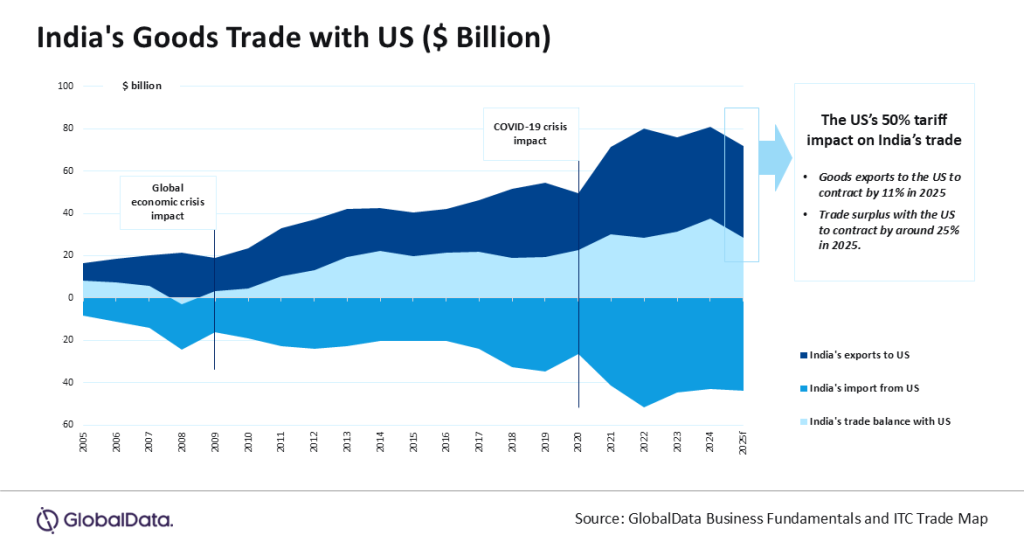
GlobalData anticipates the repercussions to be particularly severe on sectors such as textiles, gems and jewelry, machinery, iron and steel, and automotive, which could lead to a 30 basis points reduction in GDP, along with an estimated 25% contraction in the goods trade surplus with the US in 2025.
Over the past decade, India’s trade surplus with the US has risen significantly, increasing from $19.9 billion in 2015 to $37.7 billion in 2024. This surplus has grown at an average annual rate of 6.3% during the period, with a notable surge of 15.2% in the 2023-24 period, according to GlobalData analysis using ITC Trade Map data.
The top five commodities exported to the US, including electrical machinery, gems and jewelry, pharmaceuticals, nuclear reactors and machinery, and mineral oils, accounted for 51.6% of total exports in 2024. While petroleum products, pharmaceuticals, and smartphones are currently exempt from the existing tariff structure, other sectors are likely to be significantly affected.
According to GlobalData, the tariffs are projected to result in an 11% reduction in US-bound exports in 2025, making Indian goods significantly more expensive. Consequently, a 25% decline in India’s trade surplus with the US is anticipated.
Ramnivas Mundada, Director of Economic Research and Companies at GlobalData, comments: “In 2024, the US accounted for approximately 18% of India’s total goods exports. Anticipating reduced trade with the US, India is prioritizing the acceleration of free trade agreement negotiations with the European Union, Peru, and Chile to shift around 10% of the trade to Latin American countries and the EU, and enhance the resilience of labor-intensive industries.”
While pharmaceutical, electronics (including iPhones), and petroleum sectors are currently exempt from the new tariffs, the looming threat of a potential increase in tariffs on pharmaceutical products to as high as 250% poses significant concerns for the industry. Major players like Dr. Reddy’s Laboratories, Sun Pharma, and Cipla, which rely heavily on exports to the US market, may encounter rising costs and a competitive disadvantage.
The textiles sector, including companies like Welspun India, Raymond, and Trident, is likely to face significant challenges due to the increased tariffs, leading to contract renegotiations and potential cancellations that could lower sales and profitability.
Similarly, the auto ancillary sector, represented by firms such as Bharat Forge and Sona Comstar, may experience disruptions, although the impact is expected to be less severe than in textiles.
In the gems and jewellery sector, companies like Titan and Kalyan Jewellers will be affected, as a large portion of their exports to the US may result in renegotiated contracts and reduced margins, hindering their growth and expansion efforts in the American market.
Mundada concludes: “The sweeping new US tariffs and the failure to establish a trade agreement with India signify a notable downturn in bilateral relations, highlighting underlying geopolitical tensions and trade conflicts. As India addresses its energy requirements and economic goals, both countries need to pursue a practical way forward. Rebuilding trust and encouraging open communication will be key to resolving this stalemate. The trajectory of US-India relations depends on identifying shared interests, balancing national priorities, and navigating the intricate landscape of global trade dynamics.”