Mkpoikana Udoma
Port Harcourt — Nigeria witnessed a significant rebound in foreign capital inflow in the third quarter of 2024, recording a total capital importation of $1.25 billion, a 91.35% year-on-year increase compared to $654.65 million in Q3 2023, according to the latest data from the National Bureau of Statistics, NBS.
The sharp rise in capital inflow was largely driven by portfolio investments, which accounted for $899.31 million or 71.79% of the total.
This marks a growing investor appetite for short-term instruments in Nigeria amid global economic uncertainties and domestic reforms in the financial markets.
However, the NBS noted that on a quarter-on-quarter basis, capital importation dropped by 51.90% compared to the $2.6 billion recorded in Q2 2024, reflecting investors’ cautious sentiment following global interest rate shifts and local market dynamics.
The banking sector emerged as the biggest beneficiary, attracting $579.48 million or 46.26% of total inflows, followed by the financing sector with $294.55 million (23.51%) and the manufacturing sector with $189.22 million (15.11%).
The United Kingdom remained Nigeria’s top source of capital, contributing $502.60 million (40.12%), followed by South Africa with $185.03 million (14.77%) and the United States with $163.86 million (13.08%).
In terms of destination, Lagos State retained its dominance, pulling in $650.41 million or 51.92% of total capital importation. The Federal Capital Territory (Abuja) followed closely with $600.02 million (47.90%), while Kaduna, Enugu, and Ekiti states recorded marginal inflows.
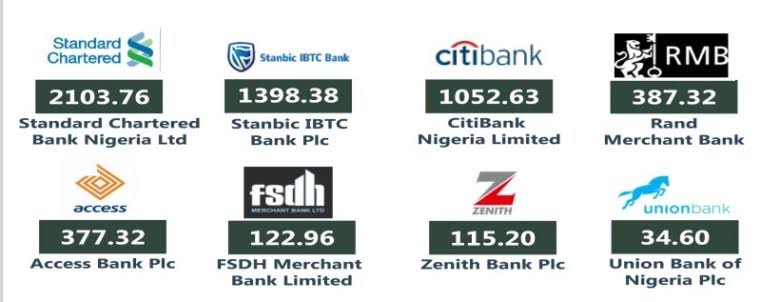
Among financial institutions, Standard Chartered Bank Nigeria Limited led the pack, receiving $385.62 million (30.78%), trailed by Stanbic IBTC Bank Plc with $382.08 million (30.50%) and Citibank Nigeria Limited with $192.88 million (15.40%).
Analysts believe the sustained dominance of portfolio inflows highlights Nigeria’s attractiveness for high-yield-seeking investors, but also underscores the fragile nature of capital importation, given its sensitivity to global monetary policies and domestic political stability.
While the uptick in capital importation is a positive signal, concerns remain over the low share of Foreign Direct Investment, FDI, which stood at only $103.82 million (8.29%), raising questions about the long-term confidence of investors in the country’s real sector.