Mkpoikana Udoma
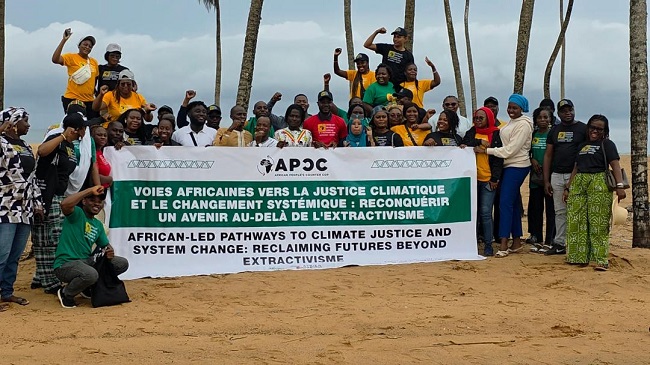
Port Harcourt — Over one hundred representatives from 20 African countries, including grassroots communities, indigenous peoples, farmers, youth, women, and civil society organizations, have issued a united call for an end to extractivism—the decades-long exploitation of Africa’s natural resources by the Global North.
The demand came at the Second African People’s Counter-COP, APCC, held under the theme “African-Led Pathways to Climate Justice and System Change: Reclaiming Futures Beyond Extractivism.”
The event, organized by the African Climate Justice Collective, ACJC, directly challenged the United Nations Framework Convention on Climate Change, UNFCCC, process, accusing it of being co-opted by capitalist interests that continue to marginalize African voices in global climate negotiations.
“The climate crisis ravaging Africa is not our fault; it is a reflection of the debt owed by the Global North,” said Rumbidzai Mpahlo, Coordinator of the ACJC.
“While we contribute minimal emissions, we endure maximum suffering. This Declaration represents our unified demand to dismantle exploitative power and reclaim our future ahead of COP30.”
From drought-stricken farmlands in the Sahel to the sinking coastlines of Ouidah in Benin, delegates painted a picture of a continent burdened by a crisis it did not create. “Africa cannot continue to serve as an extraction zone for the world’s profit while our people sink deeper into poverty,” Mpahlo added.
At the core of the APCC Declaration are nine non-negotiable demands, which they describe as a framework for systemic change and genuine climate justice.
Among these, the delegates called on wealthy nations to pay their “climate debt” through grants, not loans, halt all oil and gas exploration in Africa, and reject false solutions such as carbon trading, Net Zero schemes, and geoengineering.
“Africa’s future must be powered by socially owned, community-led renewable energy systems that serve local people first, not foreign corporations,” the Declaration stated.
Another central demand is the right of communities to say “No” to harmful projects through Free, Prior, and Informed Consent, FPIC.
The APCC also called for reforms to climate finance systems such as the Green Climate Fund, GCF, and Loss and Damage Fund, which they say are “too often controlled by profit-driven institutions rather than the communities most affected.”
On food security, the collective urged African governments to invest at least $5 billion annually in peasant agroecology, reform land laws to favor local people, and protect indigenous food systems. “Food sovereignty is climate justice,” the group emphasized.
Rejecting what it called “waste colonialism,” the APCC condemned the continued dumping of obsolete technology, textiles, and plastic waste from developed nations on African soil. “Africa is not the world’s dumping ground,” the statement declared.
The ACJC further urged African leaders to prioritize energy sovereignty by investing in people-led renewable energy systems and to protect climate refugees displaced by worsening droughts, floods, and coastal erosion.
As the world prepares for COP30 in Belém, Brazil, the APCC Declaration stands as a moral and political challenge to African governments and the international community.
“We demand that Africa speaks with one voice, a voice that rejects exploitation and insists on justice,” Mpahlo said.
In a joint communiqué, the ACJC called on African governments, policymakers, and the media to endorse and amplify the Declaration, describing it as “the true African-led pathway to address the climate, ecological, and social crises.”