11 July 2015, Sweetcrude, Port Harcourt – New York, 1948, Charles Scribners Sons published Alan Paton’s novel, “Cry, the Beloved Country,” a novel that captured indigenous South African society in the middle of the 20th century. South African society in the 1940s gave very little hope to indigenous South Africans; their homes were mainly shanty hovels, their occupations mainly manual. As for recreation, most researchers who studied that era described the natives as steeped in sex and alcohol. The people had no leaders of note and so no worthy agenda for emancipation.
Life in the Niger Delta in the 1940s was more basic. The people moved around as they desired, on foot, in dug-out canoes, with bicycles, low power boats, trucks, vans and the few automobiles that belonged to European missionaries and political functionaries. They farmed their lands, exploited their seas that teemed with varying ranges and species of aquatic life.
The seas were green, blue or blue-green. The fields were speckled with cassava, maize, yam plants, bananas, pear, mango and apple trees. The uncultivated prairies were wild, green and impossibly beautiful! The glades were thick with foliage, huge trees and animal life. There was song, dance, drama, poetry, folk lore and some religion. Sex was mainly enjoyed primarily for procreation, pursued by lovers and never indulged in as an escape. Politics was a muted whisper exchanged between school boys, district officers and clergymen. The societies of the Niger Delta in 1948 were free of political con men, fake messiahs, dishonest statesmen and yes, militants! The environment of the Niger Delta was not polluted; the air was clean, fresh and nourished human lungs in exactly as much the same way smoke fumes poison our lungs now.
Then we discovered crude oil and patriotism. Before crude oil was discovered in the Niger Delta, the indigenous people of Nigeria took pride in identifying and promoting their cultural occupations for their sustenance; the Yoruba produced their cocoa, the Hausa, maize, millet, groundnuts, cattle and partridges. The Igbo produced their own food, sold the excess but also made it their business to trade in the produce of all the regions. But when crude oil and its stupendous income potential were discovered, Nigerians forgot their manners and fell upon the Niger Delta as Yankees converged on the Gold Fields of Western America. The devastation, excavations, desecrations and despoliation commenced in earnest; the rules applied internationally to the industry were pretentiously applied much later and when the indigenous people of the Region cried out. And what manner of a cry!
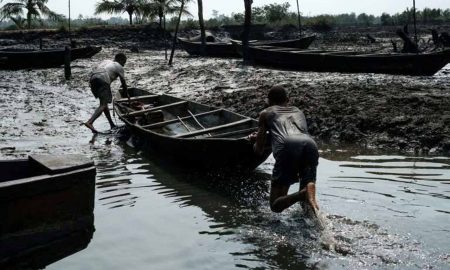
The Niger Delta has produced more “patriots” than it has, barrels of crude oil. Fake environmental activists can be bought two for a penny in the Delta. Environmental activism, militancy, economic protest, pipelines vandalism, kidnapping and other disorganised responses to the degradation of their homeland have undermined genuine protest against the inhuman conditions in the Niger Delta. This land that was once the homeland of a free people has been re-designed by strangers, speculators, adventurers and her own sons into a zone of terror. The fields are scotched and dry, the seas are browned by crude wasted during negligent production and through the deliberate vandalisation of crude bearing pipelines by natives of the Region. The streets of the Niger Delta are controlled by gangs of militants whose business range from the illegal refining of crude to the kidnapping of oil workers.
The bittersweet irony of this mix of the exploitation of the Region and the unenlightened reaction by some elements indigenous to the Region is that the capital brought in to execute the exploitation of the Region has become shy and appears to be taking flight, leaving in its wake a devastated and impoverished land and a people beaten comatose by strangers and kindred.