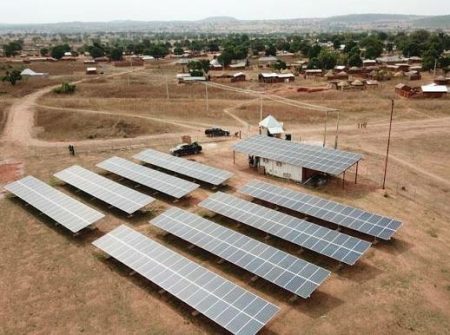
*Solar farm implemented by the Rural Electrification Agency
Goli Innocent
Lagos — The Nigerian government is continuing to put real money behind its solar ambitions, and this time, it is landing directly inside a Nigerian university. A ₦3.8 billion contract has been approved for a 2MW solar mini-grid at Aliko Dangote University of Science and Technology, Wudil and if delivered as planned, it could quietly change how power is supplied on campus.
The disclosure came from the Director-General of the Energy Commission of Nigeria, Mustapha Abdullahi, during a meeting with the university’s Vice-Chancellor, Prof. Musa Yakasai, in Abuja. According to him, the project has already been awarded by the Federal Ministry of Innovation, Science and Technology and is expected to commence soon.
“The contract for the project, which has already been awarded by the Federal Ministry of Innovation, Science and Technology at the cost of ₦3.8bn, will soon commence,” Abdullahi stated.
For a campus like Wudil, this is not just another government project it is an attempt to solve a very familiar Nigerian problem. Universities across the country spend heavily on diesel to keep basic operations running, from lecture halls to laboratories. A 2MW solar mini-grid, if properly executed, could significantly cut that cost while improving power reliability for students and staff.
Abdullahi added that the timeline is aggressive, with delivery expected within three months. “The project is expected to be completed within three months,” he said, pointing to the urgency behind the government’s broader solarisation drive.
That broader plan is what the government now calls the Renewed Hope solar initiative targeting critical infrastructure across the country. “The Renewed Hope solarisation initiative cuts across every state, and the infrastructure expected to benefit most are hospitals, tertiary institutions, and rural areas,” Abdullahi explained.
The push is not coming out of nowhere. Nigeria’s fragile power supply has had real consequences, including in the health sector. Abdullahi referenced a recent case that triggered action at the Aminu Kano Teaching Hospital, where a separate 4MW solar project was approved after reported power-related fatalities. It is a stark reminder that electricity in Nigeria is not just about comfort it is often about survival.
Beyond generation, the intervention at Wudil has already started in smaller ways. Abdullahi revealed that 200 solar-powered streetlights have been installed within the university, with another 200 units on the way. On a campus where security and night-time study conditions are constant concerns, that alone has made a noticeable difference.
The Vice-Chancellor, Prof. Yakasai, acknowledged this impact. He commended the ECN boss for his role in improving power infrastructure and campus security, noting that the streetlight installation has created a more conducive environment for students. He also pushed for deeper collaboration, particularly in renewable energy research, including the establishment of a central energy laboratory and training programmes.
What this project represents, beyond the announcement, is a test. Nigeria has seen many power sector promises come and go. The difference here will be execution. If the mini-grid is delivered on schedule and maintained properly, it could become a working model for other universities struggling with energy costs and unreliable supply.
But if it goes the way of many public projects delayed, underperforming, or abandoned it will simply join the long list of missed opportunities.
For now, the ₦3.8bn investment signals intent. The real question is whether that intent will translate into stable, uninterrupted power on ground in Wudil.