Cambridge, UK — Supercapacitors, or ultracapacitors, are an established technology, offering a compromise between the high energy density of a lithium-ion battery and the high power density and cycle life of a capacitor.
The global market for supercapacitors has seen steady growth over the last decade due to niches in automotive, power grid, and industrial applications, and will continue to do so from 2026 to 2036, with an expected global market size of US$4.86 billion by 2036. The newly-released report from IDTechEx, “Supercapacitors 2026-2036: Technologies, Applications and Forecasts”, offers in-depth independent analysis of this growing market.
Supercapacitors are one of four fundamental energy storage technologies, along with capacitors, batteries, and fuel cells. Supercapacitors are generally used in applications that require high power density and mediocre energy density, in hybrid cars, for example, where supercapacitors experience frequent charge-discharge cycles, which prevents low energy density from inhibiting usage. Often, they are used in combination with batteries in a hybrid energy storage system.
There are three main types of supercapacitor technologies, distinguished by their charge storage mechanisms and electrochemical properties, including energy density, power density, and cycle life.
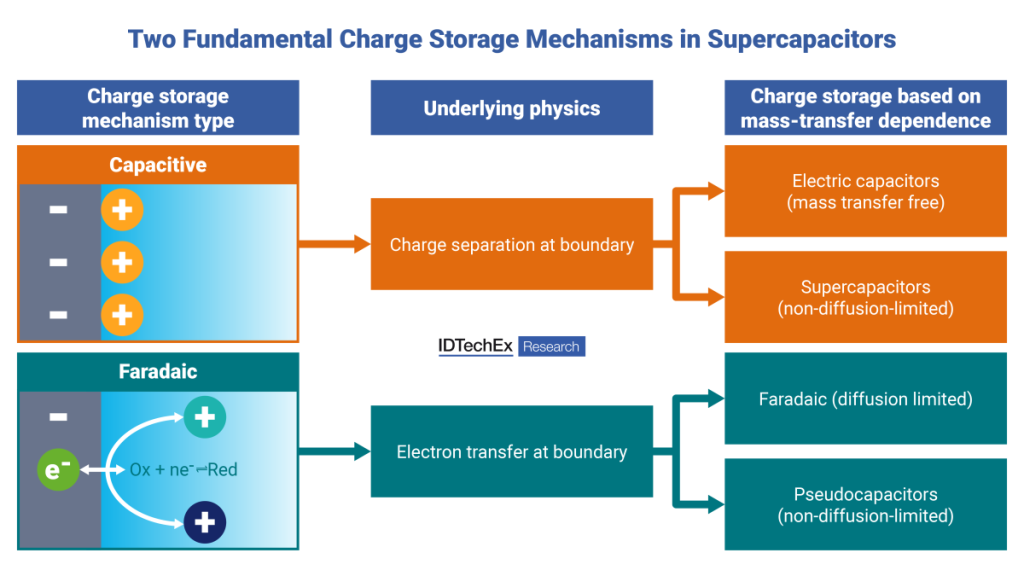
The two fundamental charge storage mechanisms in supercapacitors are capacitive storage, as is used by traditional capacitors, and faradaic storage, which describes a pair of redox half-reactions and is fundamental to batteries. Supercapacitors can use either or both, depending on the specific supercapacitor design. Electric double-layer capacitors are the most common type of supercapacitor and the best established commercially, and use capacitive charge storage.
Meanwhile, hybrid supercapacitors and pseudo-capacitors are more emerging technologies, with hybrid using a mixture of capacitive and faradaic charge storage and pseudo-capacitors using purely faradaic storage. Faradaic charge storage generally offers lower power density and higher energy density, which distinguishes the electrochemical properties of the three technology groups.
Applications
Supercapacitors are favored for applications in which high power and/or high cycle life is required, and energy density is less important. Supercapacitor developers have targeted specific niches where these conditions are met, which include uninterruptible power supply (UPS) for industry, data centres, and manufacturing; in automotives for high-power impulses or in hybrid cars, where the capacitor can be recharged through regenerative braking; in power grid for power control and peak shaving, and more.
IDTechEx predicts that the focus for supercapacitor developers will shift over the next decade, from predominantly automotive to power grid, as energy storage systems for renewable energy see increasing adoption and electric vehicle developers phase out hybrid vehicles for pure electric vehicles.
Supercapacitors face several challenges that have limited adoption, especially compared with the adoption of lithium-ion batteries, their main competitor. Energy density and cost per kWh are key to most energy storage device applications, especially in pure electric vehicles and energy storage systems, and supercapacitors are unable to compete in these metrics. In addition, the main distinguisher of supercapacitors compared to batteries is the higher power density, which previously batteries have been unable to provide.
However, as new battery chemistries are developed, e.g. solid-state, silicon-anode and lithium-metal, the gap in power density narrows and more and more batteries become ‘good enough’ for specific applications.
While batteries will never be able to fully compete with supercapacitors in certain high-power applications, due to a much lower cost per kW, the niche for supercapacitors will continue to narrow over time as battery technologies improve and new battery chemistries are developed.
The global supercapacitor market is expected to see continual growth at a CAGR of 15.3% over the next decade, due to the development of new supercapacitor technologies (hybrid supercapacitors and pseudo-capacitors), and the growth of its application markets, especially automotive and power grid.
Increasing adoption in power grid applications over automotive applications is expected, due to the rise in renewable energy storage system integrations and the predicted collapse of the hybrid electric vehicles market. To find out more, see IDTechEx’s recent report: “Supercapacitors 2026-2036: Technologies, Applications and Forecasts”.