Mkpoikana Udoma
Port Harcourt — In a move aimed at safeguarding Nigeria’s multi-billion-dollar maritime economy, the Nigerian Navy has commenced its annual sea inspection exercise, Exercise Din Mingi, deploying nine warships, helicopters, unmanned aerial assets and multi-agency tactical teams to deter piracy, oil theft, drug trafficking and threats to critical offshore infrastructure.
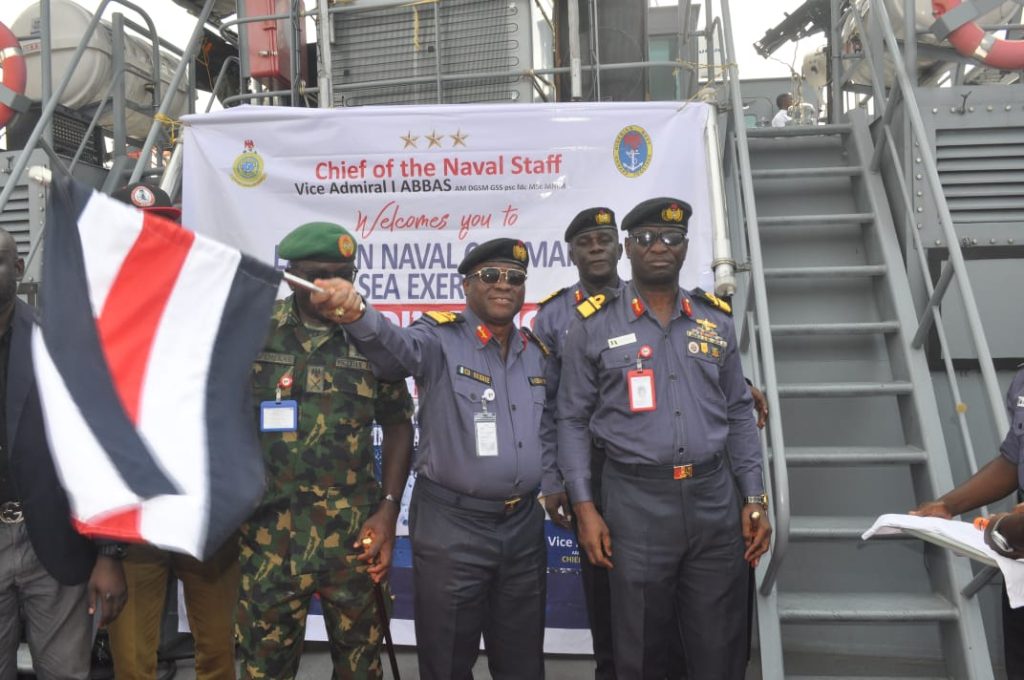
Flagging off the operation at the Federal Ocean Terminal in Onne, the Flag Officer Commanding Eastern Naval Command, Rear Admiral Chiedozie Donald Okehie, said the exercise reflects the Navy’s commitment to securing the nation’s maritime wealth, especially as the government ramps up efforts to expand blue-economy revenues.
“Ex Din Mingi encapsulates the four pillars of my command philosophy; Professionalism, Operational Readiness, Welfare and Inter-Agency Collaboration,” Okehie said. “The theme, Protecting Critical Infrastructure Through Inter-Agency Collaboration, underscores our determination to deny criminal elements freedom of action across our waters.”
The Navy, alongside the Army, Air Force and NDLEA, has mobilised an extensive fleet to sea, including nine Nigerian Navy ships; three helicopters from the Navy and the Air Force,
Epsilon EP55 UAVs, and Multipurpose assault boats from the Army and Navy.
Rear Admiral Okehie said the deployment proves the service’s combat readiness to defend the nation’s offshore oil and gas assets, shipping lanes, and revenue-generating maritime infrastructure.
“In all, nine ships, helicopters from both the NN and NAF, UAVs, as well as multipurpose assault boats from the NA and NN will be deployed,” he stated.
A key feature of the exercise is a high-risk simulation: the opposed boarding of a hijacked Liquefied Natural Gas, LNG carrier, one of Nigeria’s most valuable export assets.
“This evolution takes cognizance of the unique nature of LNG vessels and the specialized skills required to neutralize threats without compromising vessel safety and integrity,” Okehie said.
The FOC said past exercises had helped curb economic sabotage, including crude oil theft, piracy, and illegal bunkering. He noted that the Eastern Naval Command has recorded multiple arrests of vessels involved in revenue-threatening criminality.
“Notwithstanding these successes, the Command intends to rejig operations towards achieving even better results. Economic saboteurs must understand that we are better trained, better equipped, and committed to protecting Nigeria’s maritime interests.”
According to him, the exercise will run from November 18 to 19, 2025, covering vast sea areas under the Eastern Command’s jurisdiction.
Highlighting the multi-dimensional nature of the operation, the Navy said NDLEA operatives are part of the deployment to enhance anti-drug trafficking efforts.
“Some officials of the NDLEA will embark to assist in identifying psychoactive substances on suspected vessels as part of efforts to foster collaboration,” he added.
Rear Admiral Okehie said the annual sea inspection is fundamental to keeping officers prepared for real maritime security events.
“In the Armed Forces, we need continuous retraining to perform our daily operations. This exercise ensures that our men are combat ready to take on their duties.”
He reiterated the mission of the Chief of Naval Staff, Vice Admiral Idi Abbas, to deploy “a highly motivated and professional Naval Force capable of securing Nigeria’s maritime interests.”
The Flag Officer Commanding also pledged strict adherence to operational standards.
“Participating units will exhibit utmost professionalism and adherence to Rules of Engagement and Standard Operating Procedures throughout the exercise,” he said.
The flag-off ceremony was attended by senior officers from the Navy, Army, Air Force, Police, NSCDC, NDLEA, and representatives of the Nigerian LNG Limited, a sector heavily reliant on secure waterways for exports.
The operation comes amid renewed national focus on Boosting blue-economy revenue, securing crude oil export terminals, Protecting LNG shipping routes, Reducing losses to oil theft and maritime crime.
It is estimated that Nigeria loses billions annually to maritime-related criminality; losses the Navy says it is determined to reverse.
“Our waters must remain safe for commerce, investment, and national growth,” Rear Admiral Okehie emphasized.