Mkpoikana Udoma
Port Harcourt — The Nigerian Navy, Central Naval Command, has unveiled a fresh security coordination roadmap with oil majors and maritime stakeholders, declaring Nigeria’s ambitious 2.5 million barrels per day, bpd, crude oil production target achievable with tighter collaboration and sustained security enforcement.
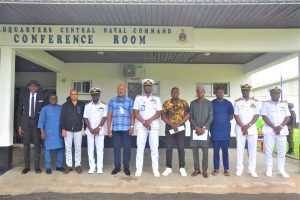
The renewed push followed back-to-back high-level engagements held on Tuesday, January 27, and Wednesday, January 28, 2026, between the Central Naval Command, major oil exploration companies, and key maritime industry players.
At the centre of the discussions was the Federal Government’s production target, which stakeholders agreed could be delivered if crude oil theft, sabotage, and operational disruptions across the Niger Delta are decisively addressed.
Flag Officer Commanding, Central Naval Command, Rear Admiral Suleiman Ibrahim, told participants that maritime security remains critical to Nigeria’s economic survival and energy ambitions.
“Maritime security is a collective responsibility,” Rear Admiral Ibrahim said.
“Sustainable outcomes can only be achieved through close collaboration and mutual understanding between the Nigerian Navy and you, our industry partners whose assets, personnel, and investments we protect.”
During the engagement with oil executives, participants jointly affirmed that President Bola Ahmed Tinubu’s 2.5m bpd mandate is “doable and achievable”, provided security agencies and industry operators align operations, intelligence sharing, and response strategies.
Rear Admiral Ibrahim stressed that the Navy’s role is to create an enabling environment for uninterrupted oil and gas operations, assuring stakeholders of stronger protection for offshore and onshore assets within the Command’s Area of Responsibility.
He also conveyed the full backing of the Chief of the Naval Staff, CNS, Vice Admiral Emmanuel Ikechukwu Ogalla, noting that Naval Headquarters remains committed to deploying the required platforms, assets, and leadership to strengthen maritime security.
“The Chief of the Naval Staff is fully committed to providing the platforms and strategic leadership needed to optimise security deployments across the Central Naval Command,” the FOC said.
According to him, the dual meetings provided an opportunity to reassess the evolving security landscape, review emerging threats, and fine-tune response mechanisms in line with industry realities.
“We welcome frank and constructive engagement,” Ibrahim added. “Your feedback is vital to improving our operational effectiveness and service delivery.”
Industry stakeholders, in their responses, expressed renewed confidence in the Navy’s leadership and ongoing inter-agency cooperation, noting that improved maritime security is already translating into greater operational stability and production recovery.
The engagements ended with a shared commitment to what participants described as a “synergy of purpose”, positioning maritime security as a central pillar in safeguarding Nigeria’s oil revenues, blue economy, and broader economic recovery.