Mkpoikana Udoma
Port Harcourt — Nigeria is accelerating its shift from raw mineral exports to value-added processing, as the Federal Government seeks deeper collaboration with Saudi Arabia to unlock investment, technology transfer and skills development in the solid minerals sector.
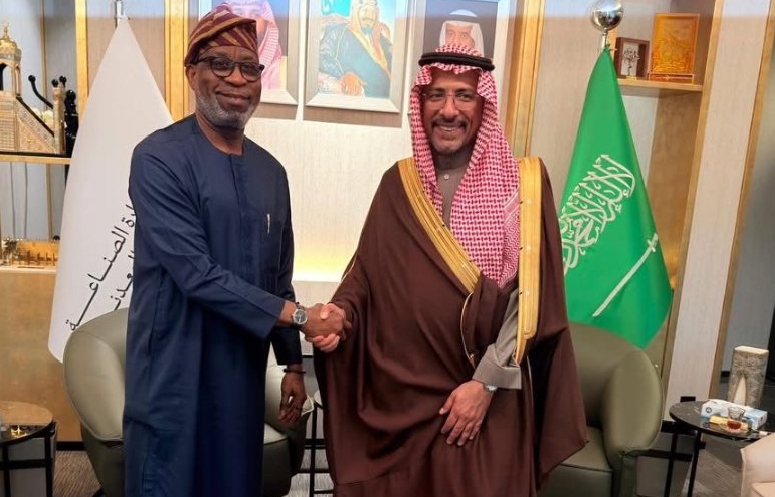
Minister of Solid Minerals Development, Dr. Dele Alake, disclosed this after a meeting with Saudi Arabia’s Minister of Industry and Mineral Resources, outlining Nigeria’s expanding downstream mineral infrastructure under President Bola Ahmed Tinubu’s Renewed Hope Agenda.
According to Alake, Nigeria now hosts a high-purity gold refinery in Lagos, with three additional refineries under development, signalling a decisive move toward domestic value addition and global competitiveness.
He further revealed that a $600 million lithium processing plant in Nasarawa State is ready for commissioning, positioning Nigeria as a key player in the global energy transition supply chain.
“These projects demonstrate that Nigeria is no longer content with exporting raw minerals,” Alake said. “We are deliberately building capacity for value addition, processing and beneficiation, to ensure greater economic returns for our people.”
The minister said discussions with Saudi authorities focused on areas of mutual benefit, including technical training, technology transfer, geological data development and mineral exploration partnerships.
Alake emphasized that Nigeria is prioritising mineral traceability, robust environmental and social standards, and effective mine rehabilitation frameworks to strengthen investor confidence and ensure sustainable sector growth.
“We are committed to building a mining sector that is transparent, responsible and globally competitive,” he said. “Strong environmental, social and governance standards are non-negotiable if we are to attract serious investors.”
He added that Saudi Arabia’s experience in developing its mining and industrial minerals ecosystem presents valuable lessons for Nigeria as it scales up its own solid minerals agenda.
According to him, the engagement marks another step in Nigeria’s broader strategy to diversify its economy, reduce reliance on oil revenues and position solid minerals as a major driver of industrialization, jobs and foreign exchange earnings.