Mkpoikana Udoma
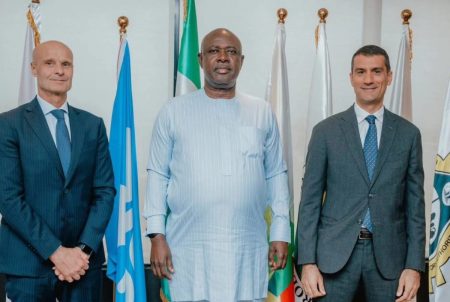
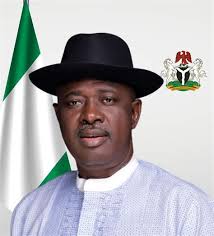
Port Harcourt — Nigeria’s Minister of State for Petroleum Resources, Sen. Heineken Lokpobiri, has said the country is strategically positioned to provide leadership across Africa in addressing the continent’s energy poverty crisis through regional integration and regulatory harmonization.
Speaking during the Ministerial and CEO Leadership Forum at the ongoing Africa Oil Week, AOW, 2025 in Accra, Ghana, Lokpobiri stressed that Africa must urgently tackle its over-reliance on fuel imports, which cost the continent more than $120 billion annually.
“Nigeria is well positioned to provide leadership across Africa, as regional integration is key to addressing Africa’s shared challenge of energy poverty. And by integration, I refer not only to infrastructure, but also to the development and harmonization of technical expertise across the continent,” he stated.
According to him, while financing remains a challenge, the bigger obstacle lies in Africa’s fragmented regulatory and fiscal frameworks, which discourage investment.
“Our biggest challenges go beyond finance, they lie in the lack of alignment in our regulatory frameworks and fiscal regimes, which investors carefully evaluate across the continent,” he added.
Lokpobiri said Nigeria has taken concrete steps to drive regional energy cooperation through the creation of the West African Reference Market, WARM, a platform designed to utilize the country’s refining capacity to serve the region.
“As part of Nigeria’s leadership efforts, we had established the West African Reference Market, WARM, a platform to utilize our refining capacity to serve the region, while advancing energy use, not abandonment, under the Paris Agreement,” he explained.
He further noted that Nigeria is investing responsibly across upstream, midstream, and downstream sectors, guided by the Petroleum Industry Act, PIA, to ensure the country contributes meaningfully to Africa’s shared energy future.
The Minister emphasized that redirecting even a portion of the continent’s $120 billion annual hydrocarbon import bill could fund critical development priorities across Africa, if countries embrace a unified energy strategy.