Mkpoikana Udoma
Port Harcourt — The Nigerian National Petroleum Company Limited, NNPC Ltd, took centre stage in Nigeria’s energy transition diplomacy at COP30 in Belem, Brazil, reaffirming its leadership in the country’s move to capture carbon finance and strengthen climate governance systems.
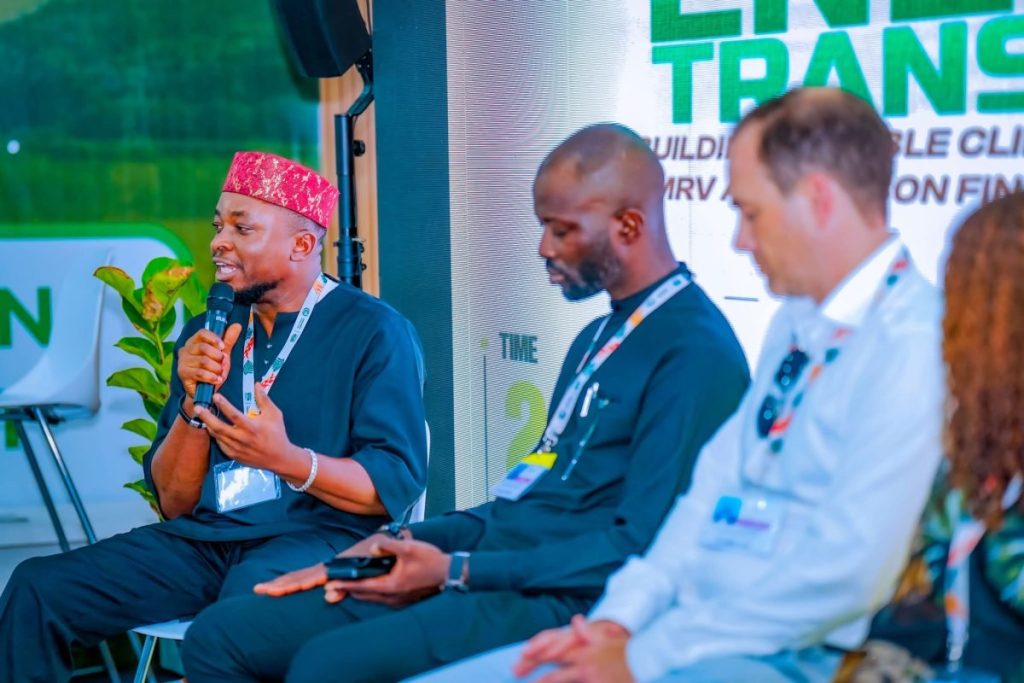
At a high-level side event titled “Strengthening Monitoring, Reporting and Verification, MRV, Systems and Unlocking Carbon Finance for Nigeria’s Energy Transition,” NNPC Ltd made a bold case for a unified national framework that would place Nigeria in a stronger position to attract global climate investments and scale methane-abatement projects.
The session, convened by the Gas Aggregator Company Nigeria Ltd/Gte, GACN, brought together senior government officials, climate-tech partners, CarbonAi, and private-sector players to align Nigeria’s fragmented carbon-governance systems.
Speaking at the event, Chinedu Igwe, Head of Sustainability at NNPC Limited, said Nigeria cannot unlock meaningful carbon finance without a harmonised MRV architecture driven by inter-agency cooperation.
“We are committed to driving alignment across all agencies responsible for climate data and carbon governance,” Igwe said. “Operationalising MRV systems is not just a technical requirement; it is the backbone of Nigeria’s carbon-market readiness and a critical step toward accessing sustainable investment.”
He stressed that NNPC Limited is stepping into a convening role to push cross-sector collaboration.
“We must accelerate opportunities for investment, especially in methane-abatement initiatives,” he added. “Nigeria cannot afford to work in silos if we truly want to deliver on our climate commitments.”
“The message is clear,” Igwe concluded. “If Nigeria is serious about carbon finance, MRV must be coordinated, credible, and nationally owned.”
Also speaking, Olamide Fagbuji, Senior Special Assistant to the President on Climate Technology and Operations, said the Presidency expects stronger inter-agency integration going forward.
“We need harmonised MRV data flows and clear carbon-market governance structures,” he said. “Our progress depends on coordinated implementation pathways, not fragmented efforts.”
Fagbuji noted that Nigeria’s ability to attract climate finance now depends on how quickly it can build a transparent, credible MRV system.
“Carbon markets reward countries that can measure and report accurately,” he said. “That is why collaboration is fundamental.”
The meeting ended with a consensus that Nigeria must move beyond sector-specific actions to a national, integrated climate-governance blueprint, anchored on NNPC Limited’s leadership.
The discussions now set the tone for Nigeria’s post-COP30 climate implementation agenda, with expectations that NNPC Ltd will lead a new model of unified MRV operations capable of unlocking significant carbon investment inflows.