Tanya Davidson
Port Harcourt — The Ogoni Peoples’ Assembly, OPA, has demanded the immediate publication of any proposed agreement on the resumption of oil production in Ogoniland, insisting that no Memorandum of Understanding, MOU, should be signed before its terms are subjected to an Ogoni-wide review and ratification.
The group also demanded disclosure of the environmental, commercial and ownership arrangements underpinning any planned return to oil production, including the identity of prospective operators, their partners and financiers, as well as proposed royalties, rents, compensation and community dividend arrangements.
The demands come amid ongoing discussions between the Federal Government and Ogoni representatives over the possible resumption of oil production. The Ogoni Dialogue Committee, ODC, has been working on harmonising positions from the dialogue process and considering an interim MOU on areas of agreement.
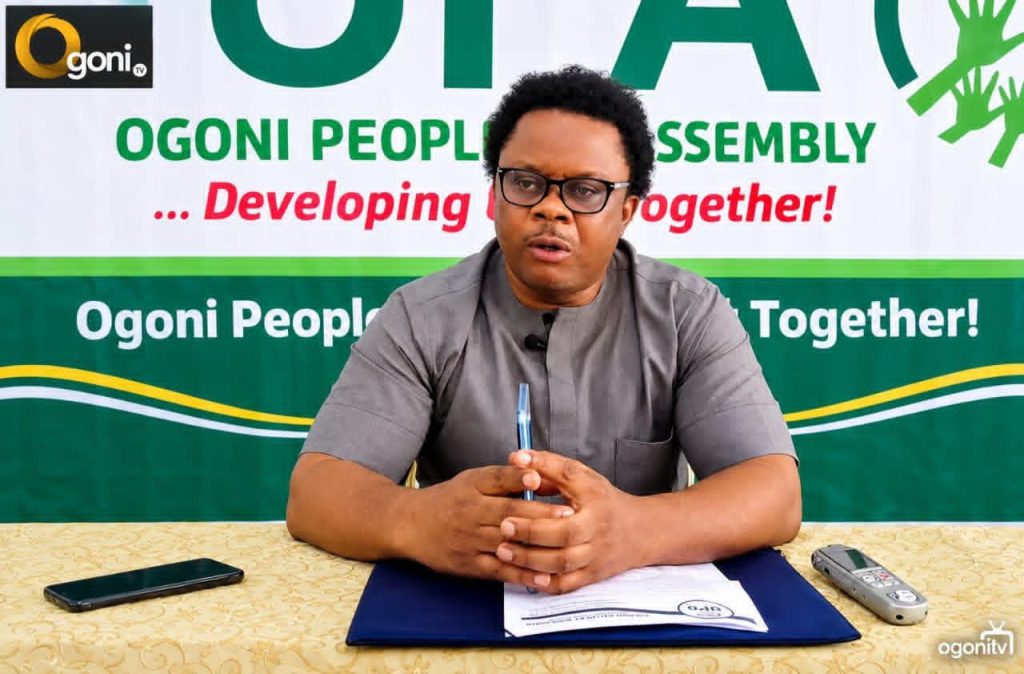
In a statement issued in Port Harcourt and Bori on Thursday, the OPA said any agreement affecting Ogoni land, resources and future must first be presented to the people for deliberation and ratification through an Ogoni Congress.
The Assembly said information reaching it indicated that an MOU could soon be signed in Abuja, but stressed that it was not passing judgment on the motives of individuals involved.
Instead, it challenged the ODC facilitation structure and the Federal Government to answer a series of questions before any signature.
“Does a draft MOU for the resumption of oil and gas production in Ogoniland exist? If so, will it be published in full, immediately, for Ogoni public review?” the group asked.
It also demanded clarification on whether the draft agreement makes the creation of Bori State a condition for oil resumption, whether environmental remediation has been independently verified, and whether current environmental data on air, soil and water quality exist.
The OPA further wants the proposed commercial terms published before any agreement is signed, including royalties, rents, compensation schedules and dividend arrangements payable to Ogoni communities.
It asked the authorities to disclose the proposed operator of the Ogoni fields, its partners, financiers and beneficial owners, while demanding that the portion of OML 11 within Ogoni territory be unbundled into at least seven Petroleum Mining Leases, PMLs.
The group wants not less than 60 per cent of the resulting licences reserved, with a right of first refusal, for Ogoni indigenous companies or genuine partnerships involving them.
OPA challenges exclusion
Beyond the proposed MOU, the Assembly protested its exclusion from the Ogoni Dialogue and Consultation process and demanded immediate representation on the ODC.
It also demanded public disclosure of the criteria used to select organisations and individuals represented on the dialogue structure.
The group said its exclusion was particularly troubling given its history of advocacy on environmental remediation, development and the creation of Bori State.
“A dialogue that shuts out credible and committed Ogoni voices is not a dialogue of the Ogoni people,” the Assembly said.
OPA also demanded publication of the identities and selection process for the 40 NNPC Limited employment beneficiaries reportedly linked to the dialogue process, as well as details of “confidence-building” contracts, including contractors, locations, contract values, award dates and execution status.
The demand comes against a backdrop of wider disagreements among Ogoni stakeholders over representation, transparency and the conduct of the dialogue. Other Ogoni groups have similarly called for greater inclusion and accountability, although positions on the proposed resumption itself differ among groups.
Bori State, remediation and ownership
The OPA said the creation of Bori State should not be treated as a separate issue to be addressed after oil production resumes.
It called on the Federal Government to sponsor an Executive Bill for the creation of the state, describing it as a demonstration of political commitment to resolving the longstanding Ogoni question.
The Assembly also insisted that environmental remediation must be completed and independently verified before renewed hydrocarbon activity.
It called for compliance with applicable environmental and petroleum laws, including public review of environmental assessments by affected communities and proper constitution of the Host Communities Development Trust.
On resource ownership, the OPA argued that restarting production under the previous structure would reproduce the grievances that contributed to the decades-long conflict over oil in Ogoniland.
It therefore proposed breaking up the Ogoni portion of OML 11 into at least seven PMLs and increasing indigenous participation in ownership.
The Assembly also rejected any militarisation of Ogoniland in connection with renewed oil activities.
Congress before agreement
The OPA formally demanded that an Ogoni Congress be convened before any MOU or other agreement is signed.
It wants the proposed MOU, ODC town-hall report, employment list, confidence-building contracts, environmental assessment, ODC membership criteria and its proposal for unbundling OML 11 placed before the Congress.
“The Ogoni people, and the Ogoni people alone, must decide whether to accept, amend or reject any agreement concerning their land,” the Assembly said.
It called on the Federal Government to suspend any planned MOU signing until the Congress has considered the terms, while urging the ODC to publish relevant documents and include OPA in its deliberations.
The Assembly said it would pursue lawful avenues, including the courts and regional and international mechanisms, if an agreement is concluded without the involvement of affected Ogoni communities and the Congress.
The OPA nevertheless said it remained committed to dialogue conducted openly and in good faith.