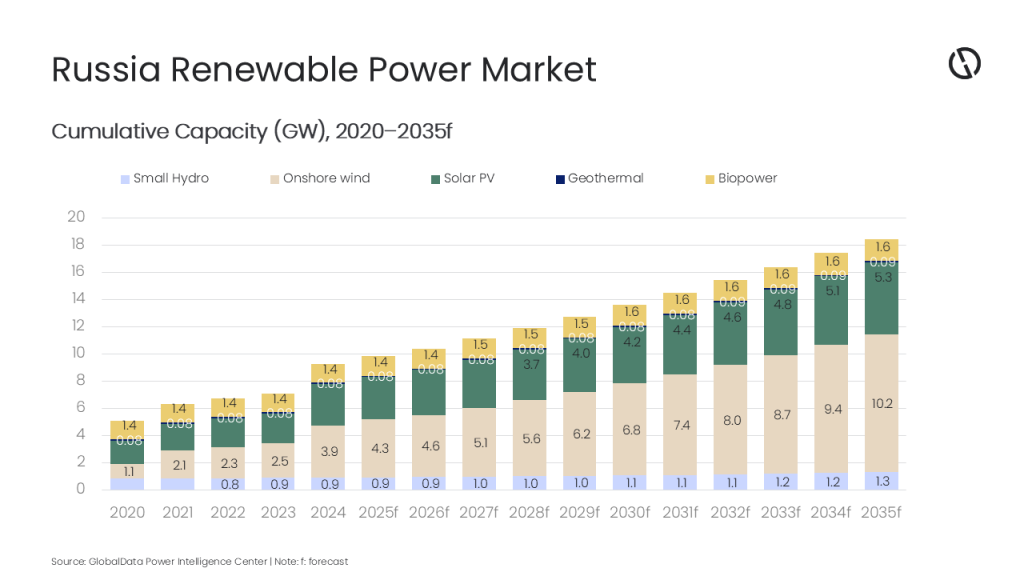
Lagos — Russia is gradually expanding its renewable power capacity while maintaining a dominant reliance on conventional and nuclear generation to ensure system stability and energy security. The country’s cumulative renewable power capacity is forecast to reach 18.4GW by 2035, up from 9.8GW in 2025, registering a compound annual growth rate (CAGR) of approximately 6.5% during 2025–35, according to GlobalData, a leading intelligence and productivity platform.
GlobalData’s report, “Russia Power Market Trends and Analysis by Capacity, Generation, Transmission, Distribution, Regulations, Key Players and Forecast to 2035”, highlights wind and solar PV as the principal drivers of renewable expansion in the country. Onshore wind capacity is projected to increase significantly from 4.3GW in 2025 to 10.2GW by 2035, supported by structured capacity supply agreements and domestic equipment localization policies. Solar PV capacity is expected to rise from 3.1GW in 2025 to 5.3GW by 2035, driven primarily by utility-scale installations across southern and eastern regions.
Renewable capacity additions are being implemented under Russia’s Capacity Supply Agreement framework for renewable energy, which provides selected wind and solar projects with fixed capacity payments for up to 15 years within the Wholesale Electricity and Capacity Market. This mechanism reduces wholesale price exposure and enhances long term revenue predictability. Domestic content requirements embedded within auction rounds have supported the development of local turbine assembly and solar module production, aligning renewable deployment with broader industrial policy objectives. Geographic resource advantages in southern Russia, the Volga region, and parts of eastern territories are further facilitating wind and solar expansion where grid infrastructure and irradiation levels are favorable.
Mohammed Ziauddin, Power Analyst at GlobalData, comments: “Russia’s renewable expansion is progressing under structured state-backed mechanisms rather than merchant market dynamics. Wind and solar projects are supported through long-term capacity payments and localization requirements, which provide investment stability while strengthening domestic manufacturing. Although renewables are increasing steadily toward 2035, their role remains complementary within a system supported by conventional and nuclear generation.”
Thermal generation continues to dominate Russia’s power mix, particularly natural gas, which accounts for the majority of installed conventional capacity. Gas-fired capacity is forecast to expand from 143.5GW in 2025 to approximately 151.2GW by 2035, reinforcing baseload supply and system reliability. Coal capacity is projected to gradually decline over the forecast period, while oil-fired capacity is expected to remain largely unchanged. Nuclear power capacity is projected to increase from 26.8GW in 2025 to 28.6GW by 2035, maintaining its position as a strategic pillar within the country’s centralized energy planning framework.
Zia concludes: “Over the next decade, Russia’s renewable focus will center on the phased rollout of CSA RES 2.0 auctions and the fulfillment of stricter localization requirements, particularly for wind and utility scale solar. Capacity additions will remain structured, and volume controlled, with priority given to domestic manufacturing development and selected regional deployment. While renewables will expand steadily, gas and nuclear generation will continue to support overall system reliability.”