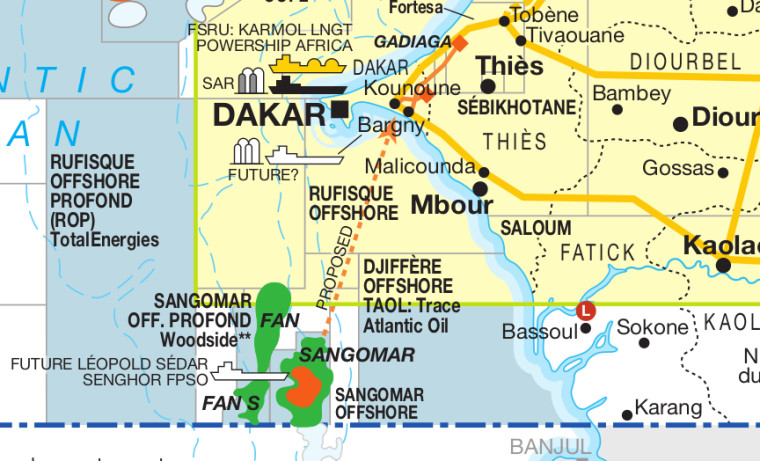
Dakar, Senegal — Senegal is advancing its industrialization agenda with renewed momentum following the commencement of major oil and gas projects. The Sangomar oil field is forecast to exceed initial production estimates, with output expected to reach 34.5 million barrels in 2025.
Simultaneously, the Greater Tortue Ahmeyim (GTA) LNG project – a joint venture with Mauritania – started LNG production last year, with plans to increase capacity in upcoming phases. These developments are set to provide a critical boost to the country’s industrial and energy transformation.
The country’s long-term development strategy, the Plan Sénégal Émergent (PSE), aims to position the country as a leading industrial and logistical hub in West Africa by 2035. The PSE emphasizes structural economic transformation, decentralization of industry away from Dakar and growth in key sectors including energy, mining, agro-industry, chemicals, construction and transport. Large-scale infrastructure projects and public-private partnership models are central to attracting investment and supporting this shift.
Energy Sector Transformation
Senegal is actively reducing its historical dependence on imported fossil fuels through both domestic hydrocarbons and renewable energy initiatives. The government’s strategy prioritizes using natural gas for domestic power generation, aiming to reduce costly heavy fuel oil consumption while directing hydrocarbon revenues toward broader development objectives.
On the renewable front, Senegal has set an ambitious Just Energy Transition Partnership target of 40% of the energy mix from renewables by 2030. Projects such as the Taiba N’Diaye Wind Power Station and large-scale solar installations are underway, although rural electrification remains a challenge. Partnerships with the World Bank and other development organizations are supporting grid expansion to underserved communities.
Transport Infrastructure Expansion
To support industrialization and regional integration, Senegal is investing heavily in transport infrastructure. The Port of Ndayane, under construction since late-2024 with DP World funding, is designed as a deep-water facility capable of accommodating larger vessels and easing congestion at the Port of Dakar. The Port of Bargny serves as a critical hub for mineral exports, including from the Falémé iron ore project. Senegal’s mining industry is a major contributor to export revenues, with phosphate, gold, mineral sands and iron ore as key resources. The government has strengthened its mining code and implemented reforms to improve transparency, fiscal management and local content policies.
Rail infrastructure improvements, such as the Regional Express Train connecting Dakar to suburban areas, and road network expansions – including the Dakar-Thiès-Tivaouane-Saint-Louis highway – are set to improve domestic and regional interconnectivity. These projects are also aligned with UN road safety targets.
Senegal is also enhancing its regional role through energy and transport integration. The OMVG interconnector links Senegal with The Gambia, Guinea-Conakry and Guinea-Bissau, expanding access to reliable electricity across borders. Regional road corridors and trade liberalization under the Economic Community of West African States aim to strengthen Senegal’s competitiveness and position the country as a West African logistics hub.
Looking ahead, the combination of new hydrocarbon production, infrastructure expansion and targeted reforms is expected to accelerate Senegal’s industrialization in 2025 and beyond. Industry leaders and policymakers are set to convene at the MSGBC Oil, Gas & Power 2025 conference and exhibition in Dakar from December 8-10, providing a key platform to align investment, share best practices and ensure that energy security gains translate into broader, sustainable economic transformation across the country.