Close Menu
    Facebook X (Twitter) Instagram
    Facebook X (Twitter) Instagram
    SweetCrudeReportsSweetCrudeReports
    Subscribe
    • Home
    • Oil
    • Gas
    • Power
    • Solid Minerals
    • Labour
    • Financing
    • Freight
    • Environment
    • Community Development
    • Renewable Energy
    • E-Editions
    SweetCrudeReportsSweetCrudeReports
    Home » Solar PV overtakes wind to lead India’s sustainable power transformation

    Solar PV overtakes wind to lead India’s sustainable power transformation

    March 5, 2021
    Share
    Facebook Twitter LinkedIn WhatsApp

    Lagos — Wind energy led India’s renewable transformation for more than a decade. Solar PV, though a late starter, has now overtaken the wind installed capacity to emerge as the top clean energy producer in the country as of January 2021, according to GlobalData, a leading data and analytics company.

    As per the Ministry of New and Renewable Energy, solar PV, including ground-mounted and rooftop, reached 38.8GW in January 2021 as against the 38.7GW wind. With the policy push ushering the growth impetus, solar PV is likely to maintain its lead and further grow to an estimated newly-built capacity of 107GW between 2021-2030 agaist the likely 64GW of wind.

    Ankit Mathur, Practice Head of Power at GlobalData, comments: “With in a span of six years starting in 2011, solar PV could only reach 40% of the total wind installed capacity in 2016. However, its installation capacity reached on par with wind by the end of 2020 and then overtook by the end of Jan 2021.”
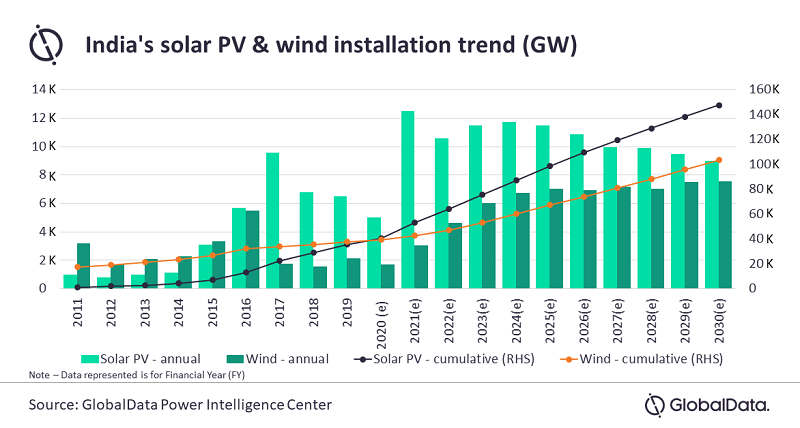
    Some of the reasons for this exponential growth are the presence of abundant solar PV resources spread across the various states, declining equipment and development costs, smaller gestation period and a rigorous focused push by the government.

    The cost factor plays a key role in solar getting preference over wind. The drop in the levelized cost of electricity (LCOE) for RE technologies over the last decade has been significant in the country. The drop in the LCOE for wind has been around 65% compared to 85% drop in solar.

    Mr Mathur concludes: “With the government planning to provide the domestic solar manufacturing a renewed thrust post-COVID-19, the solar PV sector is poised to reap benefits by attracting new investments, which will further strengthen the project development activities and consolidate the domestic manufacturing capabilities.”


    Related News

    Aso Rock dumps national grid over ₦47bn annual power bill

    Mambilla power fraud: Witness explains FEC document certification dispute

    Tinubu ramps up power access with 1,000 mini-grid projects

    Comments are closed.

    E-book
    Resilience Exhibition

    Latest News

    Nigeria courts global energy partnerships at Calgary summit

    June 15, 2026

    Nigeria targets oil revenue gains as IMF backs reforms

    June 15, 2026

    Domestic gas sales jump 30% as reforms strengthen market confidence

    June 15, 2026

    New green building framework aims to reshape Nigeria’s construction sector

    June 15, 2026

    Nigeria’s $11bn coastal highway faces growing environmental backlash

    June 15, 2026
    Demo
    Facebook X (Twitter) Instagram
    • Opec Daily Basket
    • Oil
    • Power
    • Gas
    • Freight
    • Financing
    • Labour
    • Technology
    • Solid Mineral
    • Conferences/Seminars
    • Community Development
    • Nigerian Content Initiative
    • Niger-Delta Question
    • Insurance
    • Other News
    • Focus
    • Feedback
    • Hanging Out With Markson

    Subscribe for Updates

    Get the latest energy news from Sweetcrudereports.

    Please wait...
    Please enter all required fields Click to hide
    Correct invalid entries Click to hide
    © 2026 Sweetcrudereports.
    • About Us
    • Advertise with us
    • Privacy Policy

    Type above and press Enter to search. Press Esc to cancel.