 *Minister backs NEITI audit of sector
Oscarline Onwuemenyi
29 February 2012, Sweetcrude, ABUJA –The Federal Government has noted that contribution by the solid mineral industry to the nation’s economy may have risen to about 11 percent in the past one year.
The drastic rise from less than three percent over the years has been attributed to the recent reforms in the sector, which has enhanced operations within the sector as well as paved way for private investment by foreign and local companies.
The Minister of Mines and Steel Development, Arc. Mohammed Sada, stated this in an interview with our correspondent in Abuja, in the background of the Public Presentation of the Interpretation Products of the Airborne Geophysical Survey of Nigeria Phase 2 and Geological Survey by the Nigerian Geological Survey Agency, NGSA.
Sada noted that, “Nigerians are already benefitting from the reforms in the mining and minerals sector. The reports we are getting now is that the contribution of the sector has risen to about 11 percent.
“Go out there and see: people are making a lot of money from mining in the country. This is why despite the supposed dangers that are associated with the activity, many more people are going into the sector and making a lot of money.
“The benefits to individual operators are apparent, but what we need to do is to streamline the process properly, and to find ways to make it contribute more to the coffers of government.”
He added that, “We also know that there is a lot of revenue coming from the sector that is not declared nor accounted for by the operators. Our work is to ensure more effective regulation that will ultimately improve efficiency and accountability as well as reduce or eliminate corruption.”
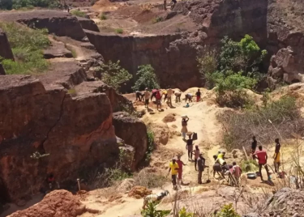
He explained that most of the small and artisanal mining activities still remain informal and therefore does not remit much to the Federal government in forms of tax and royalties, adding that his ministry’s focus was to improve regulations that would make it easy for small and artisanal miners to be formalized.
According to the Minister, the solid minerals sector remains one of the fastest growing sector in the economy, with the potential of replacing oil as the major source of revenue to the government.
He noted that, “Nigeria we all know is richly endowed with a wide range of solid minerals which, if properly managed and exploited, has the potential of becoming the springboard of our non-oil economic growth. Of remarkable importance is the fact that ere is no state in the country without the presence of at least one type of solid mineral deposit.”
He added that by its nature, the mining industry has a capacity for both backward and forward value chains that can sustain wealth creation, employment generation, poverty reduction, development of rural communities, and production of feedstock for local industries.
Sada explained that as of today, more than thirty-eight foreign companies holding 421 exploration licenses have commenced exploration activities in the country, adding that the first major gold mining company was already operating in Osun State, Messrs Retel Mining Limited, where the occurrence of over 620,000 ounces of gold has been established by the firm.
The Minister acknowledged that a lot of revenue coming from the sector is lost due to poor monitoring and ineffective structure, noting that most of the discrepancies within the would be corrected with the proposed audit of the industry to be conducted by the Nigeria Extractive Industries Transparency Initiative (NEITI).
“On the Ministry, we have also inaugurated a committee on revenues to help the government focus on expanding revenue collection from the sector to enable government provide those infrastructural services that are needed to build a more vibrant economy,” Sada added.