JOHANNESBURG, South Africa — As the European Union (EU) restructures its plans for energy security in light of shifting geopolitical realities, the Africa-Europe Roundtable – organized on the first day of African Energy Week 2022 (https://www.AECWeek.com/) in Cape Town – addressed the role of the African continent in advancing the global energy revolution and supplying Europe with energy security.
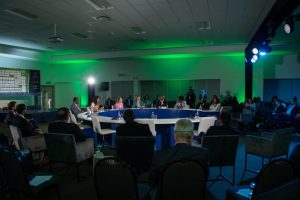
Roundtable speakers included Hon. Gwede Mantashe, Minister of Mineral Resources and Energy of South Africa; Eng. Fuad Mosa, General Supervisor of Local Content, Risks and Crises Management, Ministry of Energy of Saudi Arabia; Rebecca Enonchong, Founder and CEO of AppsTech; Nangula Uaandja, CEO of the Namibian Investment Promotion Development Board; Mary Burce Warlick, Deputy Executive Director of the International Energy Agency (IEA); and Anja Casper-Berretta, Head of Energy Security and Climate Change in sub-Saharan Africa, Konrad Adenauer Foundation. The panel was moderated by Eleni Giokos, CNN Anchor and Correspondent.
“We are heavily dependent on coal generation. Renewables now supply only about 10% of energy in South Africa. But the first problem we have is the polarized energy debate, which doesn’t achieve solutions. We must transition, but we must be very practical in our transition,” began Hon. Gwede Mantashe, South Africa’s Minister of Mineral Resources and Energy, on the current state of the energy mix.
“We believe that the new energy mix will have everything – coal, oil, gas, renewables. All types of energy creation will continue,” added Eng. Fuad Mosa, General Supervisor of Local Content, Risks and Crises Management for Saudi Arabia’s Ministry of Energy. “The world has been blessed with resources and our ultimate goal is securing the right volumes of energy at the right price. In Saudi Arabia, we will continue accelerating oil and its role in the global energy mix, while natural gas and renewable energies also need to be expanded.”
To date, African oil producers have largely exported crude oil to China, with a few exceptions of North African producers who export to Europe. However, current sanctions against Russian gas and the ongoing war in Ukraine has reignited interest in African hydrocarbon and renewable energy projects alike, which could result in billions of new investments into emerging energy markets like Namibia, South Africa, Uganda, Kenya, Mozambique and Tanzania.
“In Namibia, there have been recent discoveries of oil and gas,” noted Nangula Uaandja, CEO of the Namibian Investment Promotion Development Board. “At the same time, we are one of the few countries where renewables can be produced at relatively low prices. How can we produce energy at lower rates so that we can export to Europe? It is definitely possible to use countries like Namibia, where our carbon emissions are already some of the lowest in the region.”
“From the European perspective, for a long time, the acute need for access to energy was not so dominant,” said Anja Casper-Berretta, Head of Energy Security and Climate Change in sub-Saharan Africa, Konrad Adenauer Foundation. “Yet in Africa, you can’t have an energy transition discussion in countries where more than half of the population doesn’t have access to electricity. So energy security comes from a very different angle. How do we assure energy security? Diversification is a key component. Since the Russian invasion of Ukraine, there has been a more practical approach to finding pragmatic solutions to the current crisis.”
Making an Africa-Europe energy trade a reality – even later down the line – will be contingent on ensuring the availability of financing solutions for energy infrastructure development. Prior to the outbreak of the Russia-Ukraine conflict, a growing number of multilateral financial institutions had reduced or eliminated their support of fossil fuels altogether, in accord with the Paris Agreement and climate concerns. Now, the African continent will need to strengthen ties with the West and its associated financial institutions to forge global energy partnerships and guarantee energy security and project stability.
“Unlocking financing for investment is crucial for addressing not only the clean energy transition, but also the energy access issue,” stated Mary Burce Warlick, Deputy Executive Director of the IEA. “Our estimates show that in order to achieve universal access to electricity 2030, 90 million would need to gain access on average every day from now until 2030. This will require $25 billion in investment. It’s not impossible, but it will require clear policy and commitment and a more flexible approach to financing.”
“In the issue of funding, we also have to think about risk capital,” added Rebecca Enonchong, Founder and CEO of AppsTech. “A lot of the risk capital that goes into energy projects does not go to local entrepreneurs. A few years ago, a famous start-up in Nairobi raised about $260 milion for pay-as-you-go solar panels – and failed – because no one knew how to fix and maintain them. We need to look at where the capital is going. Is it going to local founders who understand the local ecosystem and needs of the people and build wealth?”
“In South Africa, we have not run across the problem of a lack of funding,” contrasted H.E. Minister Mantashe. “There is a lot of money going into renewables. The issue is that the money that goes into renewables does not compensate us for what we lose by moving out of the existing sectors. When funding for coal stops and flows to renewables, the capacity to help the same number of people is not comparable. It’s not apples and apples. You get less energy from more megawatts from renewables.”
For Africa, new investments could be critical to capitalizing on untapped hydrocarbon reserves left behind in the midst of the energy transition and green lending behavior. According to Rystad Energy, renewed European interest for African gas could boost African production from 260 billion cubic meters per day in 2022, to nearly 500 billion cubic meters by the late 2030s.
Follow us on twitter