Mkpoikana Udoma
Port Harcourt — As Nigeria amplifies its pivot toward the Blue Economy, a familiar undercurrent is surfacing in the Niger Delta, skepticism.
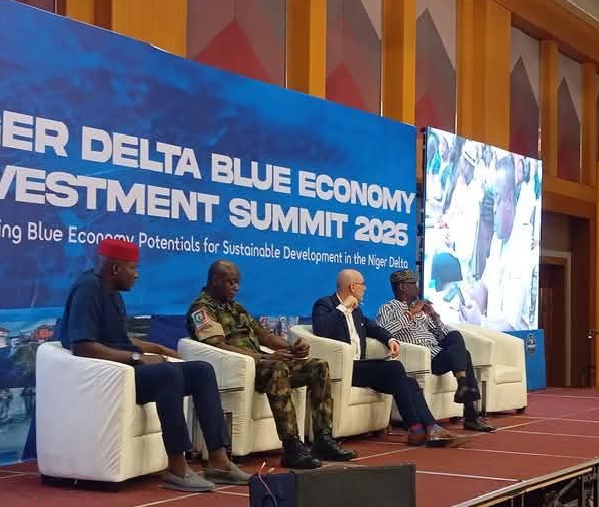
At the 2-Day Blue Economy Investment Summit held at 4-Points by Sheraton Hotel, in Ikot Ekpene, Akwa Ibom State, conversations went beyond policy frameworks and investment projections. They circled back to memory, decades of oil exploration that left deep environmental, economic and psychological scars across host communities.
For many participants, the central concern was clear: can the region trust another resource-driven promise?
Communities whose lands were explored for crude oil are still grappling with polluted creeks, degraded farmlands and unresolved compensation disputes. Against that backdrop, several piercing questions shaped discussions at the summit:
“What would happen to Niger Deltans if their land and water become unusable together?”
“If the questions raised in the old economy are being swept under the carpet, who will address those of the new economy when they arise?”
“What happens to resource allocation, clean-up and the general effect on human and aqua health?”
These were not rhetorical questions. They reflected lived experience.
Oil Legacy, Lingering Wounds
Among those urging caution were renowned environmental advocates including Ken Henshaw of We the People and Rev. Nnimmo Bassey of Health of Mother Earth Foundation, alongside Celestine Akpobari and Barr. Iniro Wills.
Henshaw challenged long-standing narratives around oil spill causation.
“Oil spill is often caused by infrastructural failure whereby pipelines are left for decades to rust and corrode. But when these pipelines burst, the blame is put on host communities,” he said.
He added that instead of accepting responsibility, government agencies and oil companies often resort to blame-shifting, leaving affected communities in prolonged legal and environmental limbo.
For the panelists, Nigeria’s slow pace of access to justice fuels distrust. Without timely remediation and accountability in the oil sector, they argued, assurances about the Blue Economy ring hollow.
They also warned against ocean bed mining, describing it as a potential replay of onshore environmental degradation.
“It would amount to pollution of the water, distortion of its habitats and the exploitation of its resources,” a participant noted, drawing parallels with past extractive practices.
A Call for Vision, Not Fear
Yet not all voices were skeptical. Former Prime Minister of Tunisia, H.E. Mehdi Jomaa, urged stakeholders to anchor the Blue Economy transition in strategic clarity and long-term vision.
“Without direction, even if you have the best of ideas, you’re headed for nowhere. So, it begins with having a vision without which there’s no going forward,” he said.
He described the summit as a “locomotive start,” emphasizing that ideas must translate into structured action if they are to deliver sustainable impact.
Governors Back Diversification
Political leaders also lent their voices to the conversation. Governor Pastor Umo Eno of Akwa Ibom State and Governor Siminalayi Fubara of Rivers State, represented by senior government officials, described the convergence as timely and necessary.
They framed the Blue Economy as a pathway to socioeconomic diversification, job creation, enhanced food security, marine transportation development and ecosystem preservation.
According to them, the summit would culminate in a comprehensive roadmap capable of addressing both regional challenges and future prospects.
The event indeed featured the launch of the Niger Delta Blue Economy Roadmap and the Niger Delta Blue Economy Development Fund, signaling institutional commitment to structured implementation.
Between Hope and History
Still, beneath the optimism lies a deeper, unresolved tension. The Niger Delta’s hesitation is not opposition to diversification. It is a demand for safeguards, transparent governance, enforceable accountability, equitable resource allocation and genuine livelihood replacement frameworks.
For decades, oil promised prosperity but delivered mixed outcomes. As the region stands at the edge of another resource frontier, stakeholders are asking a fundamental question: will the Blue Economy be different?
Until concrete mechanisms address the failures of the past, trust may remain the most fragile resource of all.