Goli Innocent
Lagos — A major breakthrough in solar technology has emerged from Switzerland, where engineers have deployed what is now regarded as the world’s largest retractable solar roof a system that could reshape how renewable energy is integrated into industrial spaces.
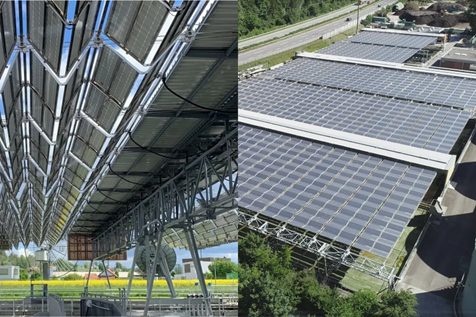
Installed at the ARA Thunersee wastewater treatment plant in Uetendorf, the project spans about 20,000 square metres and delivers 3 megawatts peak (MWp) capacity. Built by dhp Technology, the structure uses an “origami-style” design that allows the solar panels to fold and unfold depending on weather conditions.
Unlike conventional solar installations, the system is designed to adapt. It retracts automatically during heavy snow or strong winds, thereby protecting the infrastructure while maintaining operational efficiency. This flexibility marks a significant shift from static solar designs, especially in regions with harsh weather conditions.
More importantly, the project demonstrates how solar can be embedded into existing industrial facilities without requiring additional land. By installing the canopy over wastewater treatment basins, the facility has effectively turned previously unused space into a productive energy asset.
This approach is particularly relevant for countries facing land constraints or competing land-use demands. Rather than expanding outward, energy infrastructure can now be layered onto existing operations, improving efficiency without disrupting core activities.
For energy planners and sustainability leaders, the development signals a growing trend towards multi-functional energy systems where infrastructure serves both operational and power generation roles simultaneously.
Although still at an early stage, such innovations could influence how large-scale solar projects are deployed globally, especially in industrial zones. As the push for cleaner energy intensifies, adaptable and space-efficient solutions like this are likely to play a more prominent role in the energy transition.