– Six African projects funded in 2024, including in Kenya and Egypt
– Yuan loans replace dollar in China’s Africa strategy shift
– BU data shows shift to cautious lending, strategic partnerships
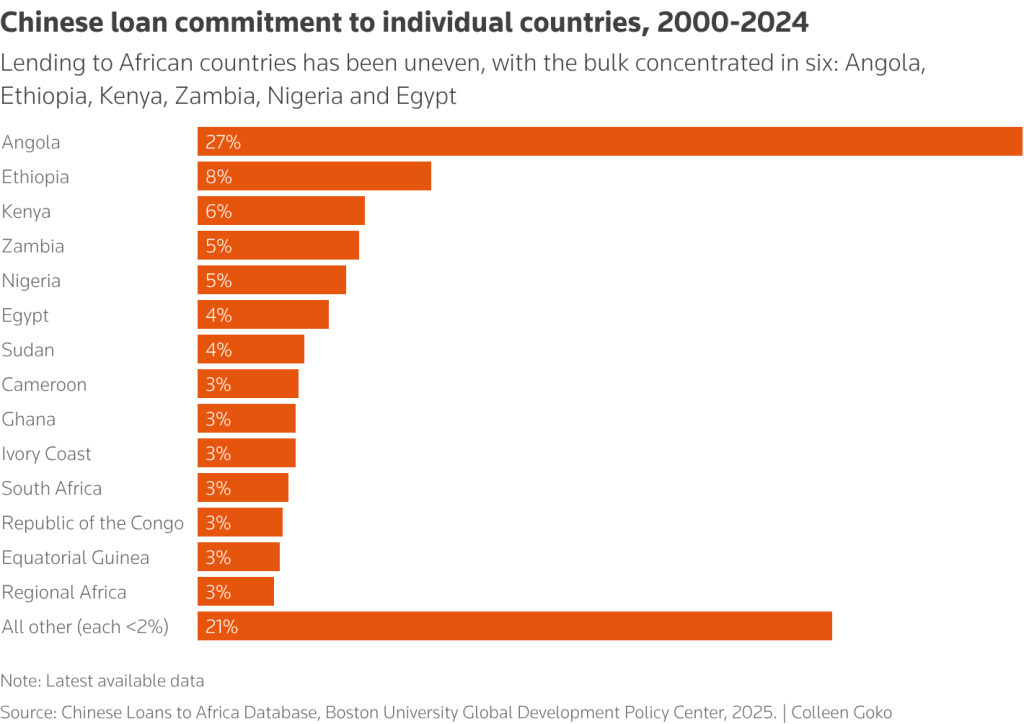
Johannesburg — Chinese lending to Africa nearly halved to $2.1 billion in 2024, the first annual decline since the COVID-19 pandemic, as the country shifts to selective, strategic projects, according to data released on Wednesday by Boston University.
The lending, which is less than a tenth of the $28.8 billion peak in 2016, reflects China’s move away from large infrastructure projects such as railways and roads and toward smaller, commercially viable projects, according to Boston University’s Global Development Policy Center.
“As the era of billion-dollar projects winds down, China’s evolving financial instruments may define a new, more selective phase of engagement,” the report said, noting that Chinese lending had consistently exceeded $10 billion annually between 2012 and 2018.

Beijing found itself taking losses on some loans after the economic stress of the pandemic pushed Zambia, Ghana and Ethiopia into default.
The university’s Chinese Loans to Africa Database, which tracks lending to the continent going back to 2000, found that China has increasingly pivoted away from dollar-denominated megaprojects characteristic of the early Belt and Road Initiative and toward targeted, smaller-scale financing denominated in yuan.
“China increasingly employs RMB-denominated loans, small and medium-sized enterprise (SME) on-lending via domestic banks in African countries, and (foreign direct investment),” the report said, pointing to a shift to FDI rather than traditional development loans.
In 2024, the most recent year for which data is available, all Chinese infrastructure loans to Kenya were yuan-denominated, the research showed.
Kenya also converted $3.5 billion worth of loans from Beijing to yuan in October. Ethiopia is also considering the shift, while the China Development Bank and the Development Bank of Southern Africa signed a deal last year for the first yuan-denominated financing cooperation.
Financing for projects exceeding $1 billion also declined noticeably in favor of funds channeled via regional African banks and directed toward projects perceived as commercially viable.
So, I think there’s a real risk to white-collar workers.
In 2024, China funded just six projects across the continent – two in Angola, and one each in Kenya, Egypt, the Democratic Republic of Congo, and Senegal.
Angola, which secured $1.45 billion for power grid and road upgrades, emerged as the top recipient, reflecting Beijing’s focus on long-standing partnerships and strategic projects.
“Taken together, the data point to a pattern characterized by more conservative direct lending, coupled with market-based financial tools that reduce costs, mitigate debt risk, and support sustainable growth objectives,” the Boston University Global Development Policy Center concluded.
*Colleen Goko; editing: Matthew Lewis – Reuters