Precious Anga
Lagos — Civil society organisations and environmental advocates have intensified calls for the Federal Government to declare a state of emergency in Bille Kingdom, Rivers State, following more than six months of persistent gas seepage that residents say is contaminating water sources and threatening lives.
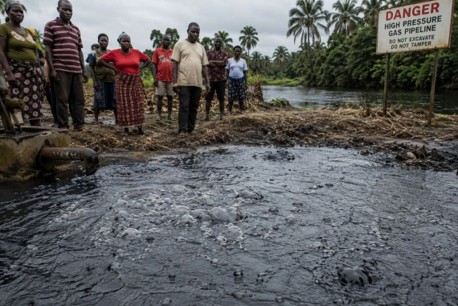
The demand follows an assessment visit by environmental groups to the riverine community in Degema Local Government Area, where gas has reportedly continued to bubble from the ground and surrounding water bodies, raising concerns over public safety and environmental degradation.
Executive Director of Social Action, Isaac Osuaka, who led the delegation, described the situation as an unfolding environmental disaster requiring urgent federal intervention.
“As we moved around the community, we saw gas bubbling from beneath the earth and on the water everywhere. The water wells that the people depend on for drinking are already polluted,” Osuaka said.
He criticised what he described as a slow and inadequate response from relevant government agencies despite repeated appeals by affected residents.
According to him, visits by the National Oil Spill Detection and Response Agency and assurances from the Nigerian Upstream Petroleum Regulatory Commission have yet to translate into concrete action on the ground.
Osuaka also questioned the effectiveness of emergency response measures currently in place, noting that the difficult riverine terrain would make firefighting operations extremely challenging should an explosion or fire occur.
“There is uncertainty because at any point in time there could be an unmanageable fire situation,” he warned.
He added that residents were becoming increasingly frustrated by the prolonged crisis.
“The overwhelming view of everybody is that this outrage in Bille cannot be allowed to continue because it is about the lives of the people.”
Environmental activist Ann-Kio Briggs, who joined the assessment tour, described conditions in the community as alarming and urged authorities to treat the situation with greater urgency.
“I cannot tell you how terrible it is. You don’t need to be a scientist to know that something terrible is here,” she said.
Briggs expressed concern about the risk of a major fire incident and questioned why senior officials from key government institutions had not visited the affected area.
She also argued that relief materials alone would not address the core challenge facing residents, many of whom now struggle to access safe drinking water.
The Chairman of the Eastern Zone of the Ijaw Youth Council, Datolu Sukubo, accused authorities of failing to appreciate the scale of the threat confronting the community.
According to him, the absence of extensive scientific studies to determine the cause and impact of the gas seepage remains a major concern.
“The Bille situation has not occurred anywhere in Nigeria, gas bubbling in every water that the people drink. Why have they not embarked on massive subsidence studies?” he queried.
Sukubo warned that residents could be forced to take further action if authorities continue to delay intervention.
The growing agitation places renewed pressure on the Federal Government and regulatory agencies to investigate the source of the seepage, assess the environmental and health implications, and implement measures to safeguard lives and livelihoods in one of the Niger Delta’s most environmentally sensitive communities.
With fears of groundwater contamination, potential explosions and long-term ecological damage mounting, stakeholders insist that Bille can no longer be treated as a routine environmental incident but as a crisis requiring immediate national attention.