– Two Supreme Court rulings are in favour of Akwa Ibom -Gov Eno
– Ceding of Bakassi, for peace, not for Cross River to lose oil wells -Gov Otu
Mkpoikana Udoma
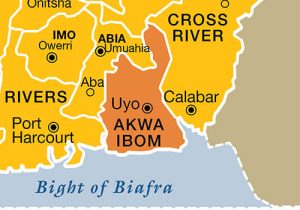
Port Harcourt — The long-running dispute over offshore oil wells in the Bight of Biafra between Akwa Ibom State and Cross River State has resurfaced, reviving questions about maritime boundaries, revenue derivation and the legal limits of administrative review in the country’s oil-dependent federation.
At the heart of the renewed tensions are reports suggesting that dozens of oil wells, often cited as about 76, are subject to reconsideration by federal institutions responsible for revenue allocation. The claims have sparked political reactions in both states, each framing the issue through different historical, legal and economic lenses.
For Akwa Ibom, the matter is a largely settled law. The state Governor Umo Eno has insisted that two rulings of the Supreme Court of Nigeria already established the state’s ownership of the offshore wells and that no administrative process can reverse those decisions.
“There are two Supreme Court judgments that give Akwa Ibom State the right to those oil wells,” Eno told newsmen. “We are not sharing maritime boundaries with Cross River State but with the Republic of Cameroun, and the Nigerian Supreme Court has said so twice.”
He urged residents to remain calm, dismissing speculation about any transfer of the oil wells as politically motivated.
“There is no cause for alarm. The people on the other side may cook up any story they want; raise propaganda, but this propaganda has no effect in the face of the two Supreme Court decisions establishing our ownership of the oil wells,” he said.
The governor also expressed confidence that the administration of Bola Ahmed Tinubu would respect the judicial rulings.
“I believe in the administration of President Bola Ahmed Tinubu; I believe that the rule of law will be respected,” he said. “We cannot throw away Supreme Court decisions twice on this particular matter.”
Legal history behind the dispute
The dispute traces its roots to the geopolitical reshaping of Nigeria’s coastal boundaries following the 2002 ruling of the International Court of Justice, ICJ, that ceded the Bakassi Peninsula to Cameroon.
Before that decision, Cross River was considered a littoral state, one with access to the sea, and therefore entitled to offshore oil derivation revenue.
But in 2012, Nigeria’s Supreme Court ruled that after Bakassi’s cession, Cross River no longer possessed a maritime boundary and therefore ceased to qualify as a littoral state for offshore derivation purposes.
That decision effectively transferred control of the offshore oil wells to neighbouring Akwa Ibom.
The 2012 Supreme Court judgment in Attorney‑General of Cross River State v. Attorney‑General of the Federation (Suit No. SC.175/2005, delivered July 10, 2012) addressed whether Cross River still qualified as a littoral state after the loss of the Bakassi Peninsula following the ICJ ruling.
One of the key passages often cited from the judgment explains the Court’s position on Cross River’s maritime status.
The Supreme Court held in substance that:
“With the cession of the Bakassi Peninsula to the Republic of Cameroon pursuant to the judgment of the International Court of Justice, Cross River State no longer has a seaward boundary and consequently ceases to be a littoral state for the purpose of entitlement to derivation from offshore oil wells.”
This reasoning formed the basis of the Court’s decision to strike out Cross River’s claim seeking entitlement to offshore oil derivation, since only littoral states with a coastline adjoining the sea can benefit from offshore derivation under Nigeria’s constitutional framework.
Legal Context
The ruling was linked to the earlier international decision in the Land and Maritime Boundary between Cameroon and Nigeria, which transferred sovereignty over the Bakassi Peninsula from Nigeria to Cameroon.
Because Bakassi previously provided Cross River’s direct access to the sea, the Supreme Court concluded that once it was ceded, the state lost the maritime frontage required to claim offshore oil wells.
Akwa Ibom’s Attorney-General, Uko Udom, reiterated that position during a media briefing, saying the legal framework remains unchanged.
“No oil well has been ceded. No Supreme Court judgment has been overturned. No constitutional provision has been amended,” Udom said.
He explained that recent claims stemmed from a misinterpretation of a draft report submitted by a federal inter-agency committee to the Revenue Mobilisation Allocation and Fiscal Commission.
“The commission clarified that what it received is a draft report, not a decision or approved recommendation,” he said. “The circulating claim is speculative and not reflective of any final position.”
Udom added that under Nigeria’s constitution, Supreme Court judgments are final.
“Under Section 235 of the Constitution, the decisions of the Supreme Court are final and binding on all authorities and persons throughout the federation,” he said. “No inter-agency committee, no technical panel, and no institutional process can alter or sit on appeal over a judgment of the Supreme Court.”
Cross River’s argument: Fairness and historical loss
While Akwa Ibom frames the issue primarily as a settled legal matter, Cross River’s political leadership has emphasised historical grievances and questions of fairness.
Governor Bassey Otu said the state’s sacrifices for national unity, particularly the loss of Bakassi, should not translate into permanent economic disadvantage.
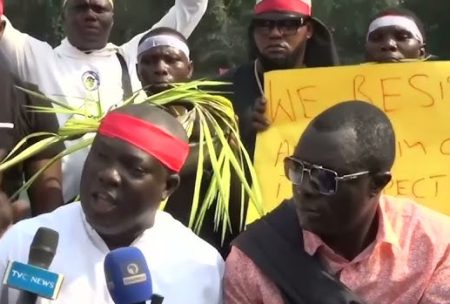
“The ceding of part of Bakassi was for peace of the country. It was not for Cross River State to lose its oil well,” Otu said while addressing supporters at the Margaret Ekpo International Airport in Calabar.
“We are full-fledged Nigerians. Nobody can deny us our right. And that time has come.”
Although the governor did not outline a specific legal pathway to reclaim the oil wells, his remarks reflect a broader political sentiment in Cross River that the state deserves reconsideration within Nigeria’s revenue framework.
Why the dispute matters economically
Beyond legal arguments, the dispute carries significant fiscal implications. Under Nigeria’s derivation principle, oil-producing states receive 13 percent of revenue generated from petroleum resources extracted within their territory. Control over offshore oil wells therefore translates directly into billions of naira in annual allocations.
Akwa Ibom has consistently ranked among Nigeria’s top beneficiaries of derivation revenue, largely because of offshore production in the Gulf of Guinea.
For Cross River, currently classified as a non-oil-producing state, the loss of offshore wells has contributed to a sharp decline in federally distributed revenue since the Bakassi ruling.
Analysts say the dispute illustrates the broader tension between legal boundaries and economic expectations in Nigeria’s federal system.
“Oil derivation has always been both a legal and political issue,” said a Lagos-based energy policy analyst who asked not to be named because of the sensitivity of the matter. “States interpret history, geography and court decisions through the lens of fiscal survival.”
Federal institutions caught in the middle
The controversy has also highlighted the delicate role of federal institutions responsible for managing Nigeria’s oil revenue framework.
The National Boundary Commission, NBC, and the Revenue Mobilisation Allocation and Fiscal Commission, RMAFC, have already denied reports that it approved any reallocation of oil wells.
But the mere circulation of draft technical documents has been enough to trigger public debate in both states, demonstrating how sensitive derivation issues remain nearly two decades after the Bakassi decision.
Politics, law and oil
For now, both states appear to be pursuing parallel narratives; Akwa Ibom emphasising judicial finality, while Cross River appeals to political fairness and historical compensation.
Governor Eno insists that the legal position leaves little room for reinterpretation. “Facts are sacrosanct, and you cannot push them under the carpet with sentiments,” he said.
Governor Otu, meanwhile, frames the issue as part of a broader struggle for economic justice. “Cross River State will not die,” he told supporters. “It’s forward ever, backward never.”
What comes next
Whether the dispute escalates into fresh litigation or remains largely political rhetoric will depend on the actions of the federal government and the willingness of the parties to pursue new legal interpretations.
For now, the debate underscores a persistent reality of Nigeria’s oil economy: offshore wells are not just geological assets; they are political and fiscal lifelines capable of reigniting old boundary disputes even decades after court rulings appear to have settled them.