 Precious Anga
Lagos — A coalition of human rights and environmental organisations has accused Shell of failing to adequately address decades of environmental pollution in Nigeria’s Niger Delta, alleging that newly disclosed internal company documents expose long-standing operational failures, ageing infrastructure and unresolved environmental liabilities.
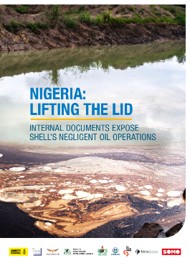
The allegations are contained in a report titled Nigeria: Lifting the Lid, jointly released by Amnesty International, The Corner House, Hawkmoth, HEDA Resource Centre, Kebetkache Women Development & Resource Centre, Miideekor Environmental Development Initiative, MEDI, ReCommon and Social Action. The report examines internal Shell emails, technical audits, confidential reviews and presentations disclosed during ongoing legal proceedings in the United Kingdom.
According to the coalition, the documents suggest Shell was aware of significant integrity problems affecting its pipelines and oil wells, yet continued production despite the environmental risks. The report also alleges that Shell exempted its Nigerian subsidiary, Shell Petroleum Development Company, SPDC, from aspects of its global health and safety standards, maintained ageing facilities beyond recommended operational limits and failed to implement adequate leak detection systems.
The report further claims Shell delayed the decommissioning of obsolete infrastructure, including an old Nembe Creek Trunk Line pipeline that company documents allegedly described as “a basket”. Amnesty said the documents showed approximately 80 kilometres of the pipeline remained filled with crude oil years after it had been replaced because decommissioning was delayed by budget constraints despite repeated warnings that additional spills were likely.
The coalition also alleged that internal company assessments estimated the cost of decommissioning SPDC’s infrastructure at approximately US$10.9 billion, excluding environmental remediation costs. Another internal presentation reportedly identified about 375 square kilometres of mangrove forest that had been affected by oil pollution in the Niger Delta.
Amnesty International Nigeria Director, Isa Sanusi, said the leaked documents challenge Shell’s long-standing position that oil theft and sabotage were primarily responsible for pollution across the region.
“Shell has long blamed oil theft and sabotage for pollution in the Niger Delta. But these documents cut through years of denial and raise grave questions about what Shell knew, what it allowed to continue, and whether it then sought to walk away from the costs of its toxic legacy.”
Sanusi added that the documents suggest the company’s pursuit of profit came at the expense of affected communities.
“The scandal was not simply illegal ‘bunkering’ or oil theft. The real scandal is Shell’s pursuit of profit at the expense of people’s rights.”
The report also alleges that Shell managers were aware illegal tapping points remained on pipelines because removing them would require shutting down crude oil production. One internal communication cited in the report said Nigerian security officials accused Shell of being “complicit” in crude oil theft because the company was not removing the illegal connections.
In addition, Amnesty said internal correspondence suggested senior company officials suspected that some employees and contractors may have been involved in oil theft, while audits reportedly uncovered extensive maintenance backlogs, inadequate oversight of pipeline repairs and incomplete records for more than 1,600 pipeline clamps, some of whose locations could no longer be verified.
The report also questions Shell’s environmental monitoring systems, alleging that a 2014 internal review found hundreds of oil wells were either missing from electronic records or their condition could not be confirmed. Amnesty said a subsequent internal “well hunt campaign” identified about 750 overdue maintenance tasks, while another review concluded SPDC lacked real-time pipeline monitoring capable of quickly detecting oil spills.
The coalition argued that these deficiencies weakened Shell’s long-standing position that most spills resulted from third-party interference. It noted that inaccurate spill classification could affect compensation claims because Nigerian law distinguishes between operational spills and those caused by sabotage.
Chairman of HEDA Resource Centre, Olanrewaju Suraju, said communities affected by oil pollution deserve comprehensive remediation.
“Shell cannot be allowed to take the oil, take the profits and leave the pollution behind. Communities in the Niger Delta deserve truth, justice, clean-up and full remedy.”
Similarly, Director of Social Action, Isaac Osuoka, argued that Shell’s divestment from its Nigerian onshore business should not shield it from environmental responsibilities.
“Shell’s divestment cannot become a corporate escape route. After decades of profiting from Niger Delta oil, Shell must not transfer the risks of ageing infrastructure and legacy pollution to communities or to a buyer whose capacity remains in serious doubt.”
Responding to Amnesty’s findings, Shell rejected the characterisation contained in the report.
According to Amnesty, the company stated:
“The characterisation and portrayal of Shell in your letter is not one we recognise. Shell is committed to honesty, integrity and respect for people, and to conducting business in an ethical and transparent manner.”
Shell also maintained that the report did not adequately reflect what it described as the “challenging operating environment in the Niger Delta at the time.”
The organisations urged the Nigerian government to strengthen oversight of the oil industry by requiring transparent audits of operational and retired infrastructure and establishing a properly funded environmental restoration programme for the Niger Delta.
They also called on authorities in Nigeria, the United Kingdom and the Netherlands to investigate whether Shell adequately disclosed the condition of its infrastructure and associated environmental liabilities to regulators, investors and affected communities.
The report comes as legal proceedings brought by the Ogale and Bille communities against Shell Plc and SPDC continue before UK courts. The Bille case is scheduled to be heard in March 2027, with the claimants seeking redress over decades of alleged oil pollution that they say has damaged water sources, farmland, fisheries, public health and livelihoods across their communities.