Mkpoikana Udoma
Port Harcourt — The Nigeria Customs Service, NCS, and the Nigerian Midstream and Downstream Petroleum Regulatory Authority, NMDPRA, are deepening operational collaboration to curb cross-border diversion of petroleum products and protect Nigeria’s domestic energy supply as local refining capacity expands.
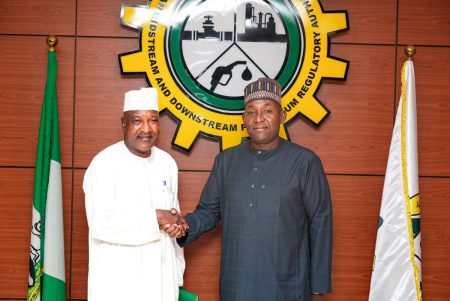
This was disclosed during a strategic meeting between the Comptroller-General of Customs, CGC Adewale Adeniyi, and the Executive Director, Distribution Systems, Storage and Retailing Infrastructure at NMDPRA, Mr. Ogbugo Ukoha in Abuja.
Adeniyi said the partnership was critical to ensuring that petroleum products meant for domestic consumption are not illegally exported, stressing that energy security remains a core national economic interest.
“We welcome every initiative that strengthens energy security and ensures that the gains made in reducing cross-border diversion are not reversed,” the CGC said.
“Our shared responsibility is to protect national interest, support legitimate trade, and maintain a transparent system that stakeholders can rely on.”
He described the joint anti-smuggling framework, Operation Whirlwind, as a major success story, noting that intelligence sharing, joint enforcement, and coordinated field operations had delivered measurable results along border corridors.
According to Adeniyi, the Customs Service remains aligned with reforms in the petroleum regulatory space and will continue to provide technical input, operational feedback, and border management expertise to support new guidelines being developed by the NMDPRA.
He also commended the Authority’s efforts to align regulatory processes with the Petroleum Industry Act, PIA, noting that clear export-point procedures are increasingly important as Nigeria transitions from a net importer to an emerging exporter of refined petroleum products.
“As Nigeria’s refining capacity grows, efficient and transparent export procedures become essential. We will continue to work closely with sister agencies to ensure these systems are credible and enforceable,” he added.
In his remarks, Ukoha said the NMDPRA values its long-standing relationship with the Nigeria Customs Service, describing Operation Whirlwind as the high point of inter-agency collaboration in tackling fuel diversion.
“Through joint deployment of personnel, intelligence exchange, and coordinated monitoring of border corridors, we have recorded a marked reduction in cross-border diversion of petroleum products,” Ukoha said.
He explained that the visit was to brief the Customs leadership on newly developed guidelines for designating petroleum product export points, particularly in view of expanding domestic refining capacity.
Ukoha said the Authority is consulting key institutions, including the Nigeria Customs Service, Central Bank of Nigeria, Federal Ministry of Industry, Trade and Investment, and the Nigerian Navy, to ensure the guidelines reflect operational realities before implementation.
He recalled joint field operations and strategic engagements, including the launch of Operation Whirlwind in Yola, where both agencies publicly reinforced their commitment to protecting Nigeria’s domestic fuel supply chain.
Ukoha added that beyond enforcement, recent economic reforms have also helped curb smuggling incentives.
“While enforcement has played a major role, the removal of fuel subsidy has significantly reduced the economic incentive for cross-border smuggling,” he said.
He assured that the NMDPRA would continue working closely with the Customs Service to sustain progress, properly regulate petroleum exports, and ensure Nigeria’s energy security is not compromised.