Precious Anga
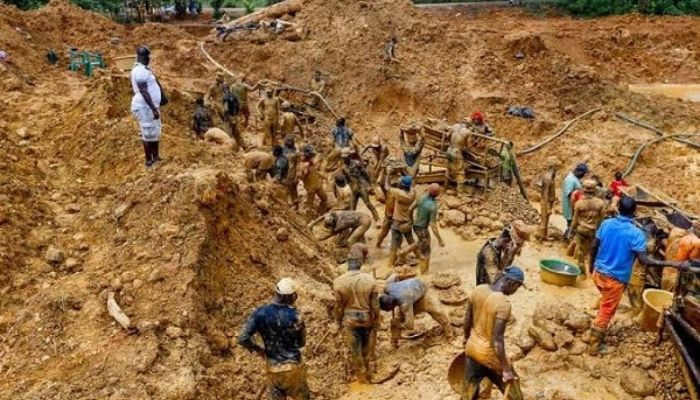
Lagos — Nigeria’s vast mineral wealth is increasingly falling into the hands of foreign syndicates, criminal networks and local collaborators, depriving the country of billions of dollars in revenue while fuelling insecurity, environmental degradation and economic losses across several states.
Despite possessing commercially viable deposits of gold, lithium, tin, columbite, tantalite and other strategic minerals, Nigeria continues to lose an estimated $9 billion annually to illegal mining, mineral smuggling, unpaid royalties, tax evasion and trade misinvoicing, according to reports by the Nigeria Extractive Industries Transparency Initiative and the Africa Network for Environment and Economic Justice. The losses dwarf the formal mining sector’s contribution to the economy, which remains below one per cent of Gross Domestic Product despite years of government efforts to diversify away from oil.
Recent investigations indicate that foreign operators, particularly Chinese nationals, have established a significant presence in Nigeria’s illegal mining landscape, often working through local proxies and shell companies to gain access to mineral-rich communities. A seven-year investigation by the Renevlyn Development Initiative titled Silent Conquest: The Chinese Infiltration of Nigeria’s Solid Minerals Sector documented widespread foreign involvement in mining operations across Zamfara, Nasarawa, Niger, Plateau, Kwara, Ogun, Abia and Akwa Ibom states.
According to the report, many foreign operators enter Nigeria on visitor visas before establishing informal mining networks in remote communities where regulatory oversight is weak. The investigation found that several of these operations generated little benefit for host communities while leaving behind degraded farmlands, polluted water sources and growing social tensions.
Executive Director of the Renevlyn Development Initiative, Philip Jakpor, warned that Nigeria risks losing control of a critical economic sector if decisive action is not taken.
“A lot of these Chinese operators come into the country as tourists but find their way into mining communities where they exploit governance gaps and weak enforcement structures. Nigeria cannot afford to lose its mineral wealth to criminal networks and opportunistic foreign actors,” Jakpor said.
Several Chinese-linked companies have already been implicated in enforcement actions by Nigerian authorities. In July 2023, the Economic and Financial Crimes Commission arrested 13 Chinese nationals linked to W Mining Global Service in Kwara State over allegations of illegal mining and non-payment of royalties. Authorities alleged that minerals extracted from the site were being processed and utilised without proper licensing or regulatory compliance.
Similarly, Sinuo Xinyang Nigeria Ltd, also identified in some regulatory documents as Sinuo Xiyan Nigeria, came under investigation after its Chinese Managing Director, Dang Deng, was arrested in Ilorin in September 2022. Authorities reportedly recovered about 25 tonnes of assorted crude minerals, including lithium, from the company’s operations.
In another high-profile case, four Chinese nationals connected to JLM Mining Company were arrested in Plateau State in March 2025. The suspects, identified as Liang Quin Yong, Wang Huajie, Zhong Jiajing and Long Kechong, were later convicted by a Federal High Court, which ordered their deportation and the forfeiture of assets valued at approximately ₦134 million.
The crackdown intensified in May 2026 when authorities arrested 15 Chinese nationals and nine Nigerians for allegedly conducting unlicensed lithium mining operations in Kokona Local Government Area of Nasarawa State. During the same month, anti-graft investigators dismantled another syndicate operating in Ogun State, leading to the forfeiture of a mining site, trucks and large quantities of lithium-bearing minerals.
Security agencies believe illegal mining has evolved beyond economic crimes into a national security concern. Intelligence reports indicate that some operators pay protection fees to armed groups controlling territories around mining sites, particularly in parts of Zamfara, Niger and other conflict-prone states. Security analysts have repeatedly warned that proceeds from illegal mining are helping to sustain banditry, arms trafficking and organised criminal activities in several parts of the country.
In Zamfara and neighbouring states, gold-rich communities have become flashpoints for violent competition among criminal groups seeking control of mining fields. The overlap between illegal mining and banditry has complicated military operations and deepened insecurity across the North-West and parts of the North-Central region.
The environmental consequences have been equally devastating. Unregulated mining activities have contaminated rivers and farmlands with mercury, cyanide and lead. One of the most tragic examples remains the 2010 lead poisoning disaster in Zamfara State, where more than 400 children died after exposure to toxic substances linked to artisanal gold processing. Environmental experts warn that similar risks persist in several mining communities where safety standards remain virtually non-existent.
Large-scale deforestation, erosion, biodiversity loss, abandoned pits and destruction of agricultural land have further undermined livelihoods in affected areas. While local communities often provide labour for mining operations, most receive little economic benefit and are left to deal with the long-term environmental and health consequences.
The Federal Government has stepped up enforcement efforts through the deployment of mining marshals, licence audits and the formalisation of artisanal mining cooperatives. Minister of Solid Minerals Development, Dele Alake, recently disclosed that more than 327 suspects, including foreign nationals, had been arrested nationwide for illegal mining-related offences, with several cases linked to organised criminal activities.
However, experts insist that enforcement alone will not solve the crisis. They argue that Nigeria must strengthen border surveillance, improve transparency in mining licence administration, dismantle protection networks shielding illegal operators and ensure that host communities benefit directly from legitimate mining activities.
Until these structural weaknesses are addressed, Nigeria’s abundant mineral resources will continue to enrich foreign syndicates, criminal networks and their local collaborators while depriving the nation of the revenue, jobs and industrial growth needed to drive sustainable development.