Mkpoikana Udoma
Port Harcourt — The Group Chief Executive Officer of NNPC Limited, Engr. Bashir Bayo Ojulari, has declared that Nigeria’s energy fundamentals remain strong, with the country now shifting decisively from policy positioning to execution and delivery.
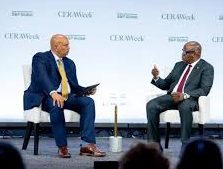
Speaking at CERAWeek 2026, Ojulari told global energy leaders that Nigeria offers a compelling investment case anchored on regulatory stability, infrastructure development, and strategic partnerships.
“Capital goes where value is clear, and Nigeria has that value,” he said, emphasizing the country’s renewed focus on translating its resource base into tangible economic outcomes.
At a high-level session moderated by Dan Pratt of S&P Global, the NNPC boss outlined a balanced energy strategy, stressing that hydrocarbons remain central to Africa’s economic reality.
“We are not choosing between today and tomorrow; we are funding the future with the present,” Ojulari stated, highlighting a model where oil drives current revenues, gas fuels industrialisation, and transition investments are pursued with discipline.
He noted that with over 600 trillion cubic feet of proven gas reserves, Nigeria is positioning gas as a strategic lever for energy security and economic growth, rather than merely a transition fuel.
Ojulari also pointed to improving investor confidence, citing the impact of the Petroleum Industry Act, PIA, in strengthening regulatory certainty.
“Nigeria is the reliable destination for energy investment the world needs,” he said, adding that enhanced security architecture, infrastructure expansion, and government-backed commercial autonomy are reinforcing the country’s competitiveness.
On upstream development, he stressed the importance of partnerships, particularly in deep water assets.
“When the fundamentals are right, partnerships scale naturally,” Ojulari said, noting that companies like Shell and Eni bring capital, technology, and execution discipline critical for projects such as OPL 245.
Addressing gas commercialisation, he identified three priority enablers including competitive pricing across the value chain, delivery of critical infrastructure such as the AKK pipeline and structuring of bankable contracts to attract investors.
He added that Nigeria is adopting a portfolio optimisation approach, balancing domestic gas supply with LNG exports to maximise both national and commercial value.
Ojulari underscored a broader strategic shift from resource ownership to resource monetisation, stressing that unlocking Nigeria’s vast undeveloped reserves will depend on fiscal competitiveness, disciplined execution, and strong partnerships.
CERAWeek 2026, hosted recently by S&P Global in Houston, brings together over 10,000 global energy stakeholders to examine the intersection of energy, technology, and geopolitics.