Mkpoikana Udoma
Port Harcourt — More than three decades after crude oil production was shut down in Ogoniland, fresh signals now point to a possible resumption of oil operations, as the Federal Government intensifies high-level engagements anchored on peace, security and community inclusion.
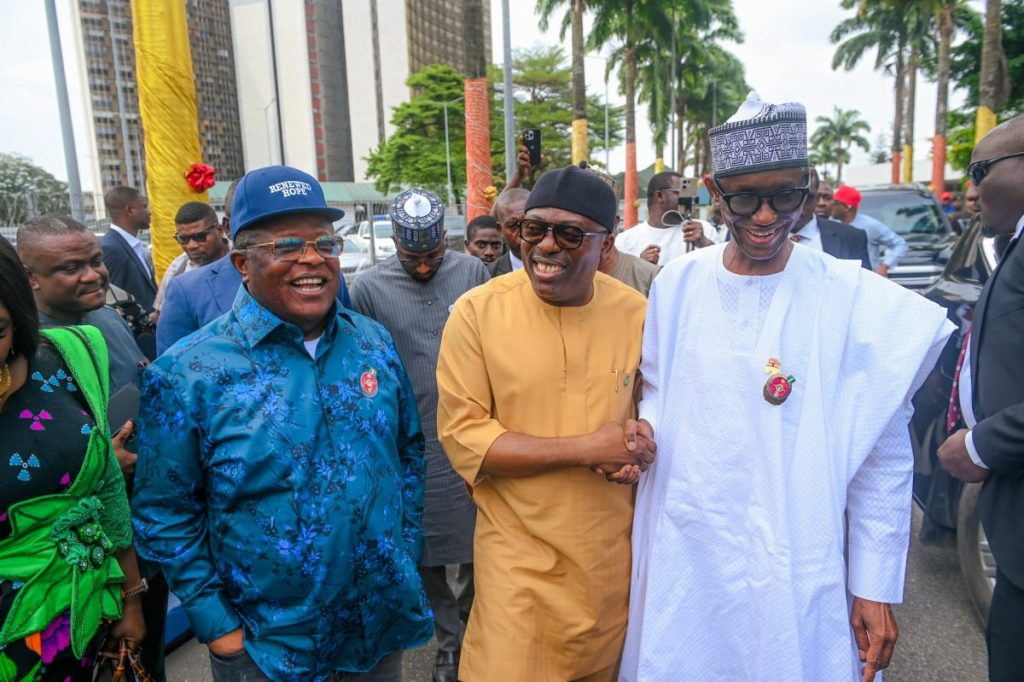
This indication emerged yesterday in Port Harcourt when the National Security Adviser, NSA, Mallam Nuhu Ribadu, led a presidential delegation to Rivers State, conveying President Bola Ahmed Tinubu’s satisfaction with the peace process in Ogoni and coordination around discussions on restarting oil exploration.
Ribadu, who described Rivers State as “one of the most peaceful states in the country,” credited the calm to the leadership of Governor Sir Siminalayi Fubara, saying the visit was aimed at consolidating peace efforts critical to the future of oil production in Ogoniland.
“A new chapter is opening in Ogoniland,” Ribadu said. “Nigeria is entering a transformative phase, and that change is beginning from Ogoni. Mr President specifically asked me to thank the governor and to express his happiness with how discussions around the possible resumption of oil exploration are being coordinated.”
He added that President Tinubu deeply appreciates the patience, understanding and cooperation of the Ogoni people, stressing that peace remains the foundation for any meaningful economic activity, including oil and gas operations.
The NSA-led delegation included the Minister of Works, Senator David Umahi; Minister of Environment, Balarabe Lawal; and the Group Chief Executive Officer of NNPC Limited, Engr. Bayo Ojulari, underscoring the strategic importance the Federal Government attaches to Ogoni.
Speaking on infrastructure critical to oil and gas logistics, Umahi said the Ogoni Peace Initiative is central to national unity and energy security, assuring that the long-delayed East–West Road would be completed to standard.
“The President takes the Niger Delta personally,” Umahi said. “The over N200 billion East-West Road project will be completed by April next year. In Ogoniland alone, the 15-kilometre Eleme axis has five flyovers, one being handled by the Rivers State Government.”
He further disclosed that President Tinubu has approved a redesign of the Lagos-Calabar Coastal Highway to pass through Ogoniland, a move seen as both symbolic and economically strategic for the oil-bearing area.
On environmental concerns that halted oil production in 1993, the Minister of Environment, Balarabe Lawal, reaffirmed the Federal Government’s commitment to the UNEP-recommended Ogoni clean-up.
“The Ogoni clean-up remains a top priority,” Lawal said. “We are making steady progress in mangrove restoration, healthcare delivery, human capital development and women empowerment.”
For NNPC Limited, the message was clear: oil discussions must now be people-focused. GCEO Bayo Ojulari said the national oil company remains fully committed to the Ogoni dialogue process.
“Our focus going forward is on the people, not just oil,” Ojulari said, disclosing that 30 Ogoni indigenes have been offered employment by NNPC Limited, with resumption scheduled for January 2026.
Responding, Governor Fubara described President Tinubu’s intervention as “decisive and genuine,” noting that resolving a crisis that lingered for over 30 years required political courage.
“For decades, this issue remained unresolved,” Fubara said. “I thank Mr President for the boldness to say, ‘Let us start from somewhere.’ Development cannot thrive in an atmosphere of instability.”
The governor also appealed to Ogoni leaders and youths to allow access to oil facilities for repairs, warning that denial of access could trigger fresh spills and undermine ongoing environmental restoration.
Oil production in Ogoniland was halted in 1993 following protests over environmental degradation linked to Shell’s operations. The area hosts five major oil fields and over 110 wells, making it one of Nigeria’s most politically sensitive hydrocarbon provinces.
With peace talks advancing, infrastructure commitments firming up, and employment signals emerging, Ogoni is once again at the centre of Nigeria’s oil conversation, this time, with community trust positioned as the new currency for production restart.