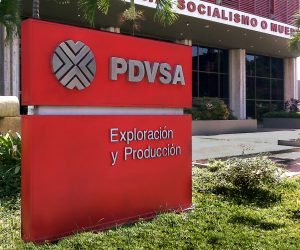
News wire — The accumulation of residual fuel inventories in Venezuela’s onshore tanks is forcing state energy company PDVSA to resort to extreme solutions to avoid shutting down refining units, as a U.S. blockade stopping tankers that are under sanctions from entering and leaving the country cuts exports to a minimum, four sources said.
Some tankers have entered Venezuelan waters in recent days and a couple of China-flagged vessels are approaching the coast. But most ships bound for Venezuelan ports for December and early January cargo deliveries have made U-turns, as the blockade spooks even vessels not under sanctions.
Washington’s pressure campaign, a bid to oust Venezuelan President Nicolas Maduro, is triggering the most severe operational crisis for PDVSA since the U.S. Treasury Department imposed sanctions on the company’s main trading partners in 2020, forcing it to switch to intermediaries to allocate its oil in China.
Those intermediaries have been using ships under sanctions and a “shadow fleet” of tankers that disguise their locations to carry sanctioned oil from countries including Venezuela.
RESIDUAL FUEL DESTINED FOR ASIA
Because it mostly produces extra-heavy crude that needs to be diluted for transportation and processed in complex refineries, Venezuela also produces high volumes of residual fuel, particularly high-sulfur fuel oil, which is typically exported to Asia.
But the U.S. blockade has reduced those shipments to a minimum in the last two weeks, according to company documents and shipping data.
After nearly filling onshore tanks, PDVSA has been storing crude and fuel oil in tankers as part of a floating storage strategy. But with some 25 million barrels of residuals already in storage, the company is running out of capacity, one of the sources said.
“They have nowhere else to store,” the person said. “Without tanker departures, the situation is getting ugly.”
PDVSA is now trying to reopen idled tanks and has begun sending residual fuel to oil waste pools in the country’s western region, an extreme solution to avoid shutdowns of operational units at the country’s 955,000-barrel-per-day Paraguana Refining Center, another source said.
PDVSA did not reply to a request for comment. Venezuela’s Oil Ministry and Maduro have said the country will keep producing and exporting its oil.
The U.S. has continued pursuing tanker seizures after intercepting two fully loaded cargoes of Venezuelan crude earlier this month.
Venezuela’s oil exports in December fell to about half the 950,000 bpd they averaged in November, according to preliminary figures. Ships chartered by PDVSA’s main partner, U.S.-based Chevron, are among the few setting sail to carry oil exports since mid-December.Venezuela
Reporting by Reuters Staff; Editing by Julia Symmes-Cobb and Rod Nickel – Reuters