Mkpoikana Udoma
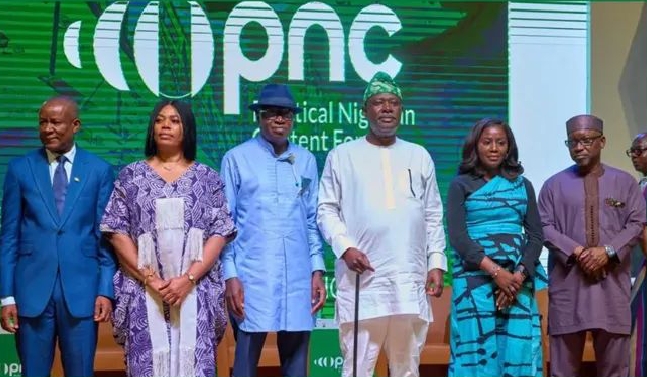
Port Harcourt — Nigeria’s energy sector is set for a decisive leap forward as government and industry stakeholders convened at the 14th Practical Nigerian Content, PNC, Forum 2025, focusing on securing investments, strengthening local content, and scaling energy production.
The forum spotlighted breakthroughs in upstream oil, midstream and downstream gas projects, and ambitious plans to expand local participation across value chains.
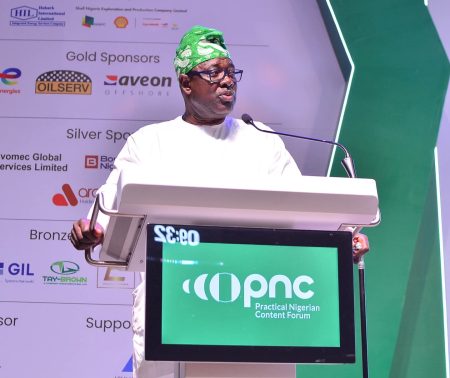
Delivering a ministerial address, Senator Heineken Lokpobiri, Minister of State for Petroleum Resources (Oil), said the country’s energy landscape has been transformed under President Bola Ahmed Tinubu’s administration, with improved regulatory stability and global competitiveness.
“A decade ago, investment was almost non-existent,” Lokpobiri stated. “The misapplication of local content laws hindered growth, inflated costs, and discouraged global players. Today, with the PIA 2021, Nigeria is ready for business.”
He urged a globally aligned investment framework, noting, “We must benchmark ourselves against Houston, Paris, and London. Investors need consistency in taxation, fees, and regulatory procedures to trust Nigeria as a production base, not just a market.”
The Minister highlighted the urgency of ramping up crude oil production and attracting strategic investments. He warned that inefficiencies in deepwater projects due to misapplied local content regulations have increased costs, calling for direct engagement with local contractors to reduce financial burdens and enhance efficiency.
“Middlemen often add unnecessary costs,” he said. “Our goal is to bring DPC contractors back into the fold and create competitive markets for indigenous companies.”
On the gas front, Rt. Hon. Ekperikpe Ekpo, Minister of State for Petroleum Resources (Gas), detailed Nigeria’s decade-long strategy under the Decade of Gas Initiative, emphasizing infrastructure expansion, domestic gas utilisation, and industrial development.
“Gas is the backbone of Nigeria’s industrial future,” Ekpo said. “From fertiliser plants to petrochemical complexes, gas powers value addition, local enterprise, and regional integration. Projects like the AKK Pipeline, OB3 Pipeline, and the Nigerian–Equatorial Guinea Gas Pipeline are unlocking markets and creating jobs.”
Ekpo outlined domestic gas initiatives, including CNG adoption, LPG penetration, clean cooking solutions for women and youth, and small- and large-scale LNG expansion. He noted that these interventions not only address energy poverty but also stimulate local enterprise.
“Local content is no longer just policy; it is a national imperative,” Ekpo stressed. “Through NCDMB’s programmes—industrial parks, human capacity development, and local manufacturing support—we are creating stronger supply chains that retain value and strengthen national capability.”
Both ministers highlighted the importance of a collaborative ecosystem. Lokpobiri stressed the need for cooperation with the National Assembly to streamline processes, while Ekpo underscored partnership with indigenous companies, universities, and research institutions to transform bright ideas into market-ready solutions.
The forum also marked a major milestone in local content financing. NCDMB Executive Secretary, Engr. Felix Ogbe, and Dr. Olasupo Olusi, MD Bank of Industry, signed an MoU for the $100 million Nigerian Content Intervention Fund, NCIF, Equity Scheme, aimed at providing equity financing to high-growth indigenous energy service companies.
“The NCIF Equity Fund will catalyse high-impact investments, support technology transfer, and enhance competitiveness,” Dr. Olusi said. “With a $5 million single obligor limit, it is designed to scale indigenous enterprises sustainably.”
The forum also reviewed the Board’s achievements, including the Project 100 companies initiative, issuance of NCDF Compliance Certificates, community contractor disbursements, and Nigerian Content Academy lectures, reinforcing Nigeria’s trajectory toward industrialisation and energy self-reliance.
Closing the session, both ministers reiterated that energy security, local content, and strategic investment form the cornerstone of Nigeria’s national development.
“Nigeria’s industrial and energy future is not ahead of us; it is in front of us, waiting to be built,” Lokpobiri said. “With clear policies, strategic investments, and local capacity development, we will unlock the full potential of our resources.”