Mkpoikana Udoma
Port Harcourt — Nigeria’s Minister of State for Petroleum Resources (Oil), Senator Heineken Lokpobiri, has issued a fresh warning to oil sector operators, insisting that companies must demonstrate active development of their assets or risk losing them under the Petroleum Industry Act’s “drill-or-drop” provision.
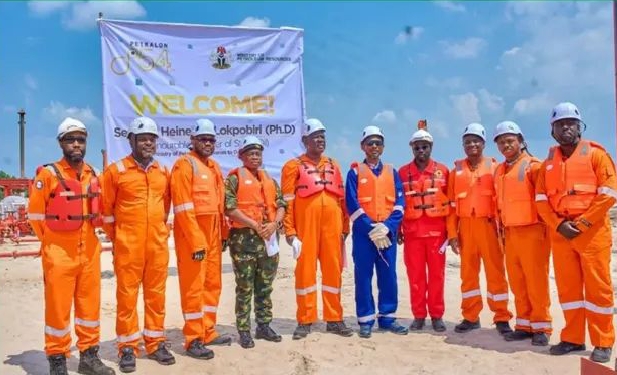
Speaking after an inspection of PETRALON Energy Limited’s field operations in Rivers State, the Minister said the Federal Government has moved beyond passive regulation and now enforces strict performance benchmarks to boost national crude output.
“We have always maintained that the era of holding licenses as souvenirs is over,” Lokpobiri said in a post on X.
“Under the ‘drill or drop’ provision of the PIA, operators must remain actively engaged in drilling activities or be prepared to relinquish such assets.”
Lokpobiri said PETRALON Energy has shown the level of commitment expected under the new regulatory regime, describing the company’s performance as a demonstration of capacity and alignment with national production goals.
“PETRALON has demonstrated commendable capacity in its operations, contributing steadily and significantly to our overall production levels. Every barrel matters, and their consistency reflects a clear alignment with our national objectives,” he said.
The Minister added that beyond statutory requirements, the Federal Government is taking “deliberate measures” to support oil sector operators who show seriousness and technical competence, noting that such support strengthens accountability.
“Because these measures are in place, we consistently hold operators accountable to deliver on expectations,” he stated.
He urged PETRALON to deepen its activities as part of the broader mandate to raise production and reinforce Nigeria’s energy security.
“I encouraged the team not only to sustain their current performance but to strategically expand their activities in line with our national mandate,” the minister said.
The remarks come amid renewed government pressure to scale up drilling campaigns, curb asset dormancy, and reverse Nigeria’s declining crude output, which has repeatedly fallen below benchmark projections.