Port Harcourt — From space, Earth is an incredible sight at nighttime. Across the planet, millions of lights illuminate coastal outlines, pinpoint populated urban areas and map out the interconnectivity between metropolitan areas.
But when you look towards Africa, the darkness is striking. It tells a sobering story of over half a billion people on the continent who still lack access to electricity, making the continent one of the least electrified regions globally. This energy gap is both a human development crisis and a missed economic opportunity.
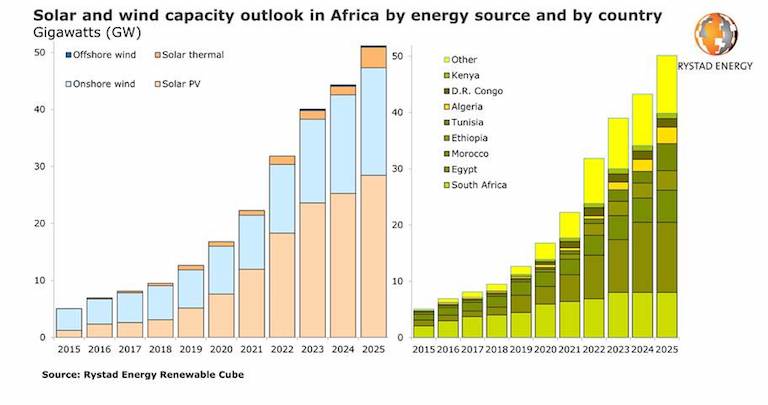
With an extraordinary endowment of renewable energy resources, Africa’s energy landscape should look vastly different. Solar photovoltaic potential alone could generate 1,5 million terawatt hours (TWh) per year. Wind power adds another 980 000 TWh annually, alongside 350 GW in hydro capacity and 15 GW in geothermal. A recent study suggests that by 2040, renewables could meet up to 80% of Africa’s energy needs. The natural abundance is, therefore, not the issue. The challenge lies in converting this potential into scalable, sustainable energy systems.7y
Africa at the crossroads of global energy transition
Africa is not only key to its own energy transformation, it is central to the global clean energy transition. Yet, despite holding 60% of the world’s best solar resources, the continent accounts for just 1% of installed solar generation capacity. The investment gap is stark: over USD 20 billion per year is required to meet Africa’s energy and climate goals by 2030, yet clean energy investment in the region comprises only 2% of the global total.
Financial capital alone is not enough. To attract meaningful investment, Africa must implement regulatory frameworks that make clean power bankable. Projects need predictability, legal protection, and risk-aligned structures to succeed. Governments must prioritise integrated, transparent policy environments that build investor confidence and unlock capital.
With South Africa assuming the G20 Presidency, there is an unprecedented opportunity to position Africa as a frontier for renewable energy deployment. Regional collaboration, underpinned by smart policy and strong governance, can catalyse the transformation from resource-rich to energy-secure.
Restore the grid before building the capacity
Africa’s power pools, including the Southern, Eastern, Central, and West African Power Pools, represent critical steps towards integrated regional energy systems. Lessons from global initiatives like the Nordic Power Market and Central American Interconnection System show that regional cooperation can deliver stable, cross-border electricity markets.
But Africa faces a more foundational issue: inadequate infrastructure. Average grid losses of 15% and poor interconnectivity mean even the best renewable projects cannot reach underserved communities. Without reliable transmission and distribution networks, capacity growth is meaningless.
The first priority must be to identify and deliver strategic infrastructure projects that expand and modernise the grid. These investments will unlock renewable energy corridors linking resource-rich areas to regions with high energy demand. From there, climate-resilient infrastructure plans can be supported by tailored G20 policy mechanisms and de-risked capital structures.
Enabling bankable execution through finance innovation
To create a truly investable environment, African energy markets need more than ambition. They require deep structuring expertise and innovative finance solutions that reflect the continent’s unique economic and political realities. Development finance institutions, multilaterals, and private banks must work in tandem to design instruments that reduce risk and ensure long-term project viability.
Absa has played a leading role in this space. In 2024 alone, the Group facilitated over R49,2 billion in sustainable finance. Notably, we arranged half of all closed projects under South Africa’s Renewable Energy Independent Power Producer Procurement Programme (REIPPPP), a flagship model for blended finance and public-private partnership in renewables.
Beyond energy, the bank’s work on the Tanga UWASA Green Bond in Tanzania led to the country’s first municipal green bond, connecting over 6 000 households to clean water. It also showcased how green capital can drive both climate impact and inclusive growth.
These projects illustrate the power of partnership, technical depth, and local insight to turn Africa’s potential into progress.
From potential to power
Africa is projected to be home to more than 25% of the global population within the next 25 years. Electrifying this growth is not just an African imperative — it’s a global one. The tools exist. The capital exists. The renewable resources are abundant. What remains is the political will, policy coherence, and financial innovation to translate ambition into action.
With decisive investment, smart regulation, and regional cooperation, Africa can lead the next wave of the global energy transition not just as a participant, but as a pioneer.
The time to act is now.
*Izaak Coetzee, Head of Strategic Insights & Analytics, Absa Group